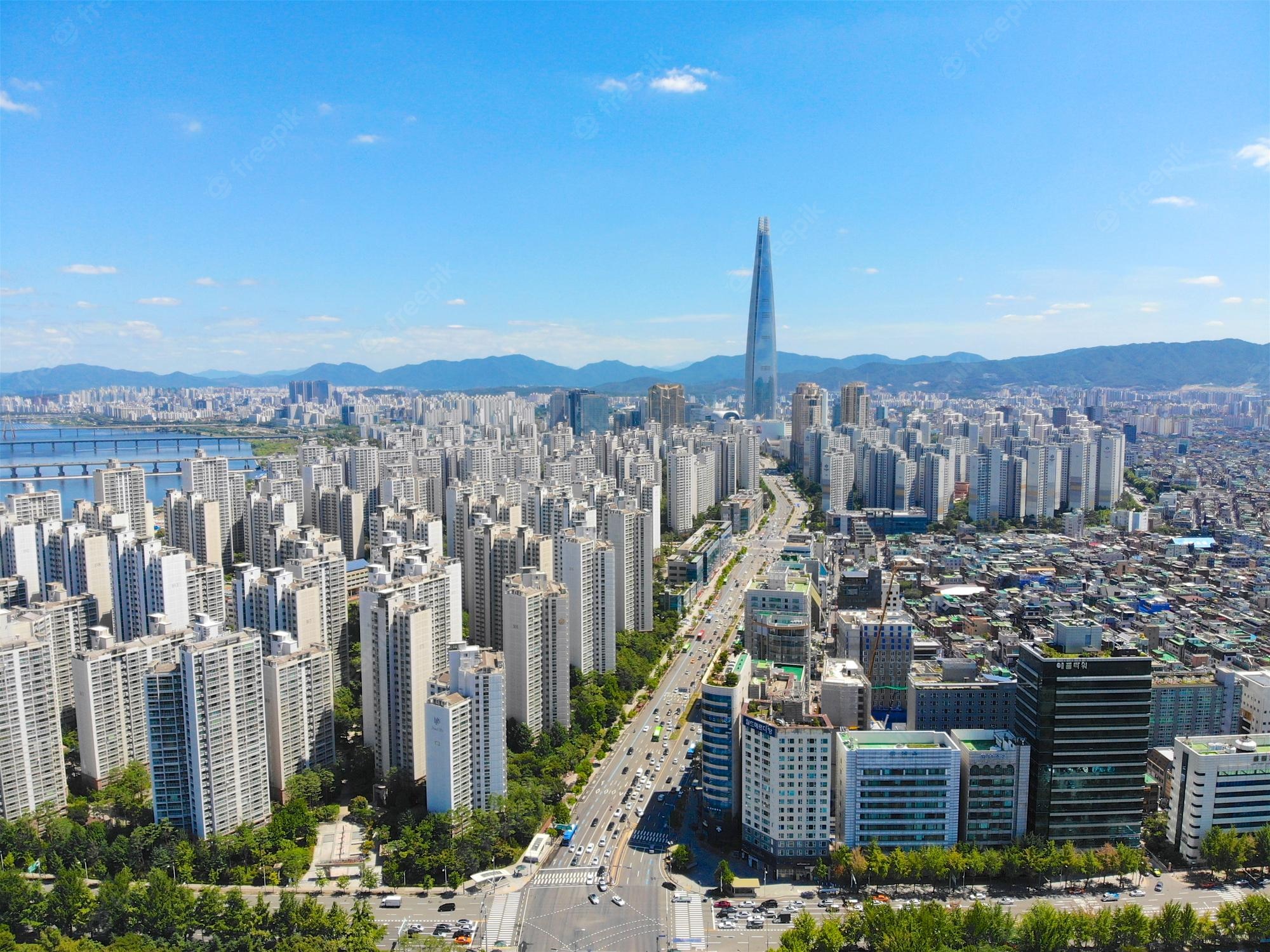
Neo-liberal economists will tell you that South Korea’s rise as an industrial powerhouse is because it followed free market ideas. Not so, says Prof Ha-Joon Chang, the South Korean economist. Nevertheless, his home country’s experience has valuable lessons for Africa. Osei Boateng reports.
In 1961, eight years after the war with North Korea, South Korea’s per capita income stood at $82, less than half of Ghana’s at the time ($179). During the war – one of the bloodiest in human history (an estimated four million people were killed in just over three years, 1950-1953) – half of South Korea’s manufacturing base was destroyed.
It was no surprise, therefore, that an internal USAID report in the 1950s described South Korea as a “bottomless pit”. At the time, the country’s main exports were tungsten, fish and other primary commodities.
Today, South Korea is an industrial powerhouse, with a per capital income in five figures. As Chang says: “It took the UK over two centuries (between the late 18th century and today) and the USA around one-and-a-half centuries (from the 1860s to the present) to achieve the same result. Korea’s progress is as if Haiti has turned into Switzerland. How has this ‘miracle’ been possible?”
Most analyses of South Korea’s rise, including Chang’s, ignore the vital fact that the country was one of the nations selected by the USA – in a chain extending all the way down from Finland, Sweden, Norway and Germany to Taiwan, Japan, etc – that were given economic, military and political help to grow into economic giants in order to act as a cordon sanitaire against the spread of communism. Nobody should forget that.
Having said that, the South Koreans still had to pull up their socks and make the “miracle” happen. Chang recalls how General Park Chung-Hee, the father of South Korea’s miracle, came to power in a military coup in 1961 and won three successive elections after exchanging his military uniform for civilian clothes.
Not democratic in the true sense of the word, Gen Park propelled the country’s success via his Five-year Plans for Economic Development. Halfway through this third term, which was due to end in 1974, he staged an “auto coup” against his own government, dissolved parliament, and guaranteed himself the presidency for life.
“His excuse,” Chang recalls, “was that the country could ill-afford the chaos of democracy. It had to defend itself against North Korean communism and accelerate its economic development. His proclaimed goal of raising the country’s per capita income to US$1,000 by 1981 was considered overly ambitious, bordering on delusion.”
But he was unfazed. In 1973, he launched a Heavy and Chemical Industrialisation Programme, which was also ambitious in its aims, but under which the first steel mill, the first modern shipyard, and the first locally-designed car (made mostly from imported parts) were built.
“New firms were set up in electronics, machinery, chemicals, and other advanced industries,” Chang remembers. “During this period, the country’s per capita income grew phenomenally by more than five times, in US dollar terms, between 1972 and 1979. Gen Park’s apparently delusional goal of $1,000 per capita income by 1981 was actually achieved four years ahead of schedule. Exports grew even faster, increasing nine times, in US dollar terms, between 1972 and 1979.”
According to Chang: “The country’s obsession with economic development was fully reflected in our education. We learned that it was our patriotic duty to report anyone seen smoking foreign cigarettes. The country needed to use every bit of the foreign exchange earned from its exports in order to import machines and other inputs to develop better industries. Valuable foreign currencies were really the blood and sweat of our ‘industrial soldiers’ fighting the export war in the country’s factories. Those squandering them on frivolous things, like illegal foreign cigarettes, were ‘traitors.’”
Imagine any African country doing that? It would be promptly charged with enacting ‘draconian laws” to restrict the freedom of its citizens. The president of such a country would be called all sorts of names, and the official opposition would be funded by Western governments and their allied institutions to overthrow (the terminology in fact is “win an election” against) such a president. The citizens of such a country, themselves, would in fact not agree to be subjected to such “draconian laws”.
But South Korea went even further than that. “Spending foreign exchange on anything not essential for industrial development was prohibited or strongly discouraged through import bans, high tariffs, and excise taxes (which were called luxury consumption taxes),” says Chang. “Luxury items included even relatively simple things like small cars, whisky or cookies …
“Foreign travel was banned unless you had explicit government permission to do business or study abroad. As a result, despite having quite a few relatives living in the USA, I had never been outside Korea until I travelled to Cambridge at the age of 23 to start as a graduate student there in 1986,” Chang recounts.
But wait for this: Like the strict rules of currency transactions in Europe under the Marshall Plan, the South Korean government took absolute control over the country’s then scarce foreign exchange. Chang recalls that the violation of the foreign exchange controls could be punished by the death penalty!
“When combined with a carefully designed list of priorities in the use of foreign exchange, it ensured that hard-earned foreign currencies were used for importing vital machinery and industrial inputs,” Chang adds.
Today, looking at South Korea’s deep pockets and the neon lights of the capital, Seoul, neo-liberal economists thump their chests and say the country has succeeded because it followed free market ideas – ie, the principles of sound money (low inflation), small government, private enterprise, free trade, and friendliness towards foreign investment.
But this is far from the truth. “The reality,” Chang insists, “was very different indeed. What Korea actually did during these decades was to nurture certain new industries, selected by the government in consultation with the private sector, through tariff protection, subsidies and other forms of government support (eg, overseas marketing information services provided by the state export agency) until they ‘grew up’ enough to withstand international competition.”
Chang goes on: “The government owned all the banks, so it could direct the lifeblood of business – credit. Some big projects were undertaken directly by the state-owned enterprises – the steel maker, POSCO, being the best example – although the country had a pragmatic, rather than ideological, attitude to the issue of state ownership.
“If private enterprises worked well, that was fine; if they did not invest in important areas, the government had no qualms about setting up state-owned enterprises; and if some private enterprises were mismanaged, the government often took them over, restructured them, and usually (but not always) sold them off again.”
Chang narrates how the government also took foreign investment under its wing and heavily controlled it with a mixture of measures. In general, the government welcomed foreign investment with open arms in certain sectors and shut it out completely in others, in line with the dictates of the national plan at any one time.
Reverse engineering – where South Korean companies stripped down a foreign product and copied it – was actively encouraged by the government, which generally had a lax attitude towards foreign patents and the pirating of patented products from advanced countries.
Says Chang: “The popular impression of [South] Korea as a free-trade economy was created by its export success. But export success does not require free trade, as Japan and China have also shown … The Korean economic miracle was the result of a clever and pragmatic mixture of market incentives and state direction.
“The government did not vanquish the market as the communist states did. However, it did not have blind faith in the free market either. While it took markets seriously, the Korean strategy recognised that they often need to be corrected through policy intervention.”
Any lessons for Africa?
Leave a Reply