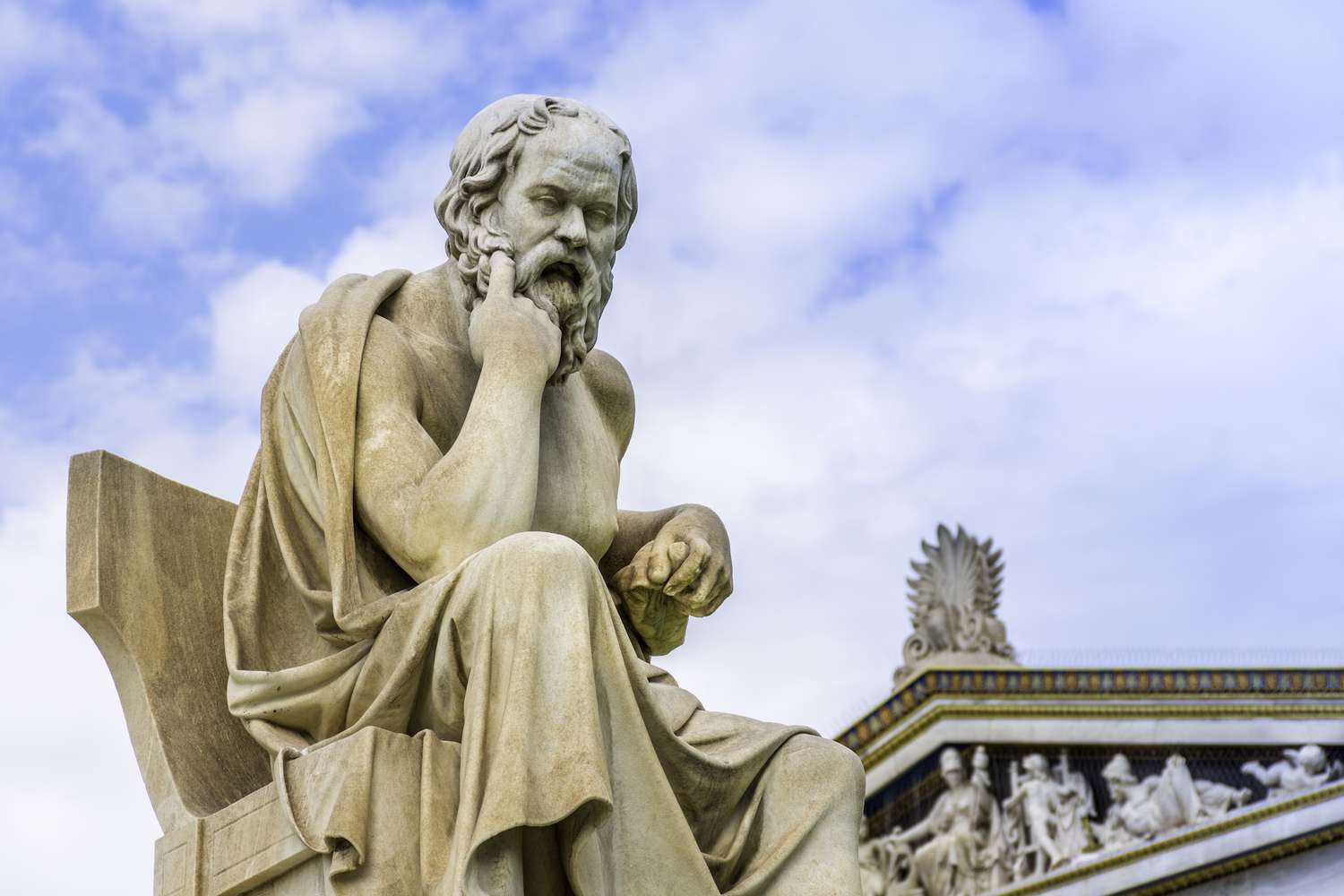
For centuries, Euro-American historians have succeeded in concealing the truth about the Greeks who travelled to Kemet in search of the knowledge of the ancient African mystic systems, and who after their study, taught by Africans, went back to influence Greek, and by extension, European thought and civilisation. In effect, the legacy of scientific and philosophic knowledge of the modern world has been wrongly credited to the Greeks, who passed it on to the Romans who passed it on to Renaissance Europe, and on to the current world. This piece is published by courtesy of The Africa Factbook.
The historical record is clear that after nearly 3,000 years of prohibition against the Greeks, they were allowed to enter Kemet to study. This was made possible, first, through the Persian invasion and, secondly, through the invasion of Alexander the Great (from the 4th century BC), up until the death of Aristotle (322 BC).
The Greeks took every opportunity to learn all they could, receiving direct instructions from African high priests who were the deans of knowledge. When Egypt came under Roman control, they looted and ransacked the great libraries of Egypt. The looting of the libraries was the genesis of Western scientific, philosophic and technical knowledge. This continued when Napoleon’s invading army arrived in Egypt in 1798 AD.
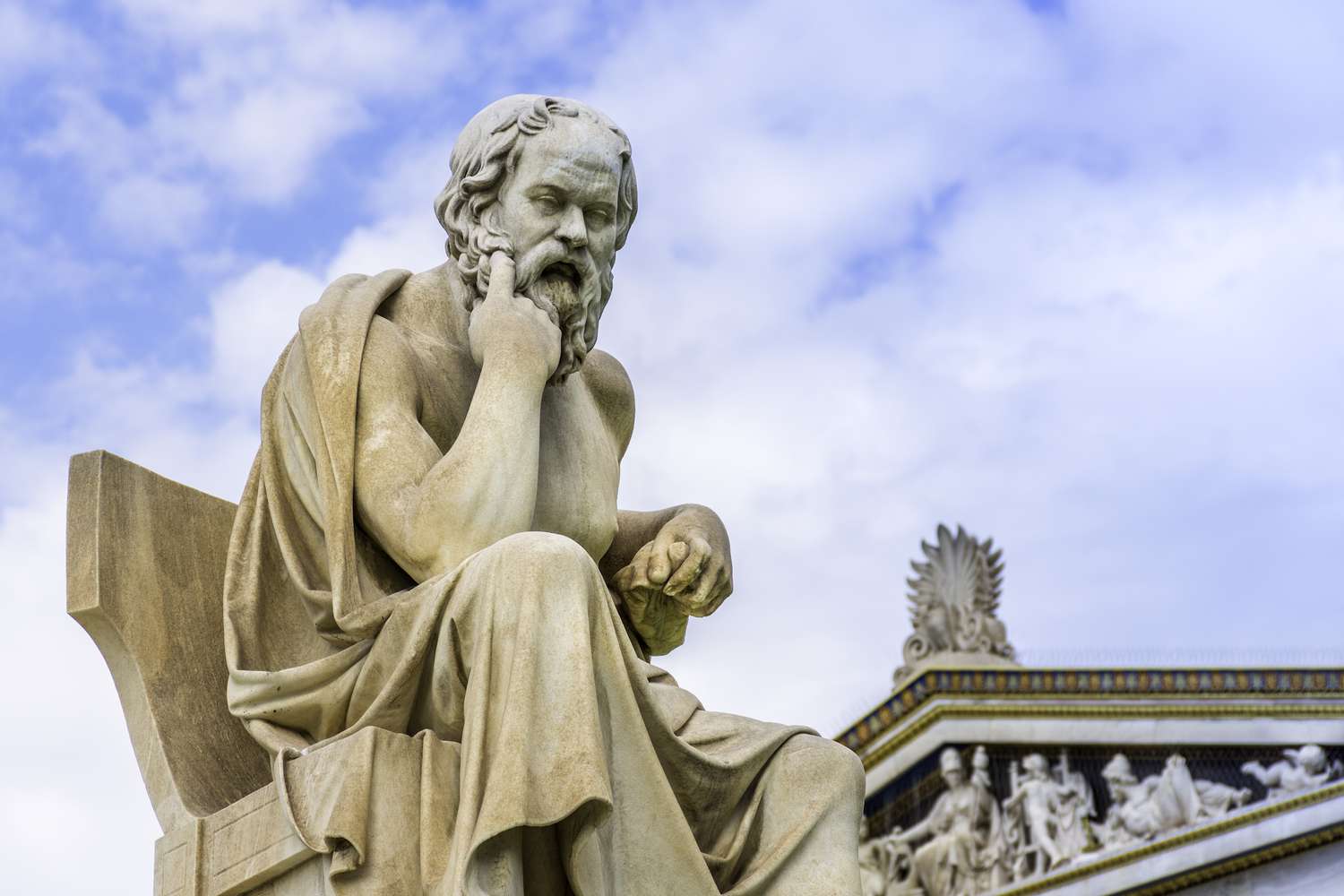
Democritus, a Greek historian, accused his fellow Greek, Anaxagoras, of having “stolen” the Egyptian mystical teachings on the sun and moon, and passed them around as his own. Socrates, one of the greatest Greek scholars, while awaiting punishment in prison for teaching African wisdom and also for his condemnation of corruption, admitted to his
pupils that he plagiarised the work of the African philosopher, Esop (also spelt Aesop, mid-6th century BC).
Socrates confessed: “I availed myself of some of Esop’s fables which were ready to hand and familiar to me and I versified the first of them that suggested themselves.”
Homer, in his Odyssey IV (c. 750 BC), praised Ancient Egypt “where the doctors are the first scientists of the world”. The death of Aristotle, who had inherited a vast quantity of books from the libraries of Egypt through his friendship with Alexander the Great, was naturally followed by the death of Greek philosophy, which fell into a system of borrowed ideas, known by themselves as eclecticism.
The collection of Greek philosophy – if not at the instigation of Aristotle himself, certainly students of his school – was not authorised by the Greek government, which persecuted the Greek philosophers as it considered philosophy as African and foreign to Greek sensibilities, and thus could lead to the corruption of the youth.
Greeks not the authors of Greek philosophy
As a result, Anaxagoras was indicted and fled from prison to exile in Ionia. Socrates was also executed for exhibiting some of the qualities mandatory for initiation into ancient African mystical teachings. Plato likewise was also persecuted and fled to Megara for refuge.
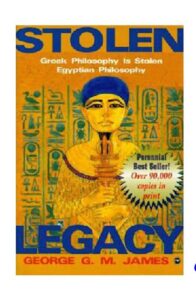
In 1954, the Guyana-born Dr George Granville Monah James, who served for two years as Professor of Logic and Greek at Livingston College in Salisbury, North Carolina, USA, before he moved on to the University of Arkansas at Pine Bluff – shocked the world when he published his book, Stolen Legacy, whose main theme was that the Greeks were not the authors of Greek philosophy; the Ancient Egyptians were.
James’ book was so radical that even the library of the University of Arkansas, a historically black college, refused to stock it. But James was not apologetic. He trusted in his research and facts.
Reviewing the book in 1955 for the Journal of Negro Education, Prof. William Leo Hansberry wrote: “In the work, Professor James dares to contend and labour to prove, among others, that ‘the Greeks were not the authors of Greek philosophy’, that the ‘so-called Greek philosophy’ was based in the main upon ideas and concepts which were borrowed without acknowledgement – indeed ‘stolen’ – by a few wayward and dishonest Greeks from the Ancient Egyptians.”
Curiously, Dr James died under mysterious circumstances shortly after the publication of Stolen Legacy. Since then nobody has bothered to present a significant biography of him. But he was clear in his mind when writing Stolen Legacy: “The term Greek philosophy, to begin with, is a misnomer, for there is no such philosophy in existence,” he wrote, matter-of-factly.
“The Ancient Egyptians,” Dr James went on, “had developed a very complex religious system, called the Mysteries, which was also the first system of salvation… After nearly 3,000 years of prohibition against the Greeks, they were permitted to enter Egypt for the purpose of their education. First through the Persian invasion and secondly through the invasion of Alexander the Great.
“From the sixth century BC, therefore, to the death of Aristotle (322 BC), the Greeks made
the best of their chance to learn all they could about Egyptian culture; most students received
instructions directly from the Egyptian priests, but after the invasion by Alexander the Great, the royal temples and libraries were plundered and pillaged, and Aristotle’s school converted the library at Alexandria into a research centre. There is no wonder then, that the production of the unusually large number of books ascribed to Aristotle has proved a physical impossibility for any single man within a lifetime.”
According to Dr James: “The history of Aristotle’s life has done him far more harm than good, since it carefully avoids any statement relating to his visit to Egypt, either on his own account or in company with Alexander the Great, when he invaded Egypt. This silence of history at once throws doubt upon the life and achievements of Aristotle. He is said to have spent 20 years under the tutorship of Plato, who is regarded as a philosopher yet he graduated as the greatest of scientists of antiquity. Two questions might be asked: (a) How could Plato teach Aristotle what he himself did not know? (b) Why should Aristotle spend 20 years under a teacher from whom he could learn nothing? This bit of history sounds incredible.
“Another point of considerable interest to be accounted for was the attitude of the Athenian
government towards this so-called Greek philosophy, which it regarded as foreign in origin and treated accordingly. Only a brief study of history is necessary to show that Greek philosophers were undesirable citizens, who throughout the period of their investigations were victims of relentless persecution, at the hands of the Athenian government.
“Anaxagoras was imprisoned and exiled. Socrates was executed. Plato was sold into slavery, and Aristotle was indicted and exiled; while the earliest of them all, Pythagoras, was expelled from Croton in Italy. Can we imagine the Greeks making such an about-turn as to claim the very teachings which they had at first persecuted and openly rejected? Certainly, they knew they were usurping what they had never produced.”
Aristotle and the books from Egypt
Dr James drove home the point, referring to Aristotle’s death in 322 BC, “not many years after he had been aided by Alexander the Great to secure the largest quantity of scientific books from the Royal Libraries and Temples of Egypt. In spite, however, of such great intellectual treasure, the death of Aristotle marked the death of philosophy among the Greeks, who did not seem to possess the natural ability to advance these sciences. Consequently, history informs us that the Greeks were forced to make a study of Ethics, which they also borrowed from the Egyptian ‘Summum Bonum’ or greatest good.”
Dr James then turned to Socrates and Plato, who also became famous in history as philosophers and great thinkers by stealing from the Ancient Egyptians, without acknowledging the source of their alleged philosophy and great thinking.
“Every schoolboy,” Dr James wrote, “believes that when he hears or reads the command ‘know thyself’, he is hearing or reading words which were uttered by Socrates. But the truth is that the Egyptian Temples carried inscriptions on the outside addressed to Neophytes and among them was the injunction ‘know thyself’. Socrates copied these words from the Egyptian Temples, and was not the author. All mystery temples, inside and outside of Egypt carried such inscriptions, just like the weekly bulletins of modern churches.
“Similarly, every school boy believes that when he hears or reads the names of the four cardinal virtues, he is hearing or reading the names of virtues determined by Plato. Nothing has been more misleading, for the Egyptian Mystery System contained 10 virtues, and from this source Plato copied what have been called the four cardinal virtues: justice, wisdom, temperance, and courage.
“It is indeed surprising how, for centuries, the Greeks have been praised by the Western world for intellectual accomplishments which belong without a doubt to the Egyptians or the peoples of North Africa… This contribution to civilisation was really and truly made by the Egyptians and the African continent, and not by the Greeks or the European continent.”
Continuing, Dr James wrote: “We sometimes wonder why the people of African descent find themselves in such a social plight as they do, but the answer is plain enough. Had it not been for this drama of Greek philosophy and its actors, the African continent would have had a different reputation, and would have enjoyed a status of respect among the nations of the world.
“This unfortunate position of the African continent and its peoples appears to be the result of misrepresentation upon which the structure of race prejudice has been built, ie the historical world opinion that the African continent is backward, that its people are backward, and that their civilisation is also backward.
“Finally, the dishonesty in the movement of the publication of a Greek philosophy becomes very glaring, when we refer to the fact…that by calling the Theorem of the Square on the Hypotenuse, the Pythagorean theorem, it has concealed the truth for centuries from the world, who ought to know that the Egyptians taught Pythagoras and the Greeks what mathematics they knew.”
The true authors of Greek philosophy
Explaining why he wrote Stolen Legacy, Dr James disclosed that he wanted to “show that the true authors of Greek philosophy were not the Greeks, but the people of North Africa, commonly called the [Ancient] Egyptians; and [that] the praise and honour falsely given to the Greeks for centuries belong to the people of North Africa, and therefore to the African continent.
“Consequently, this theft of the African legacy by the Greeks led to the erroneous world opinion that the African continent has made no contributions to civilisation, and that its people are naturally backward. This is a misrepresentation that has become the basis of race prejudice, which has affected all people of colour.”
This issue was a great worry for Dr James because, as he put it, “For centuries, the world has been misled about the original source of the Arts and Sciences; for centuries Socrates, Plato and Aristotle have been falsely idolised as models of intellectual greatness; and for centuries the African continent has been called the Dark Continent because Europe coveted the honour of transmitting to the world the Arts and Sciences.
“I am happy to be able to bring this information to the attention of the world, so that on the one hand, all races and creeds might know the truth and free themselves from those prejudices which have corrupted human relations; and on the other hand, that the people of African origin might be emancipated from their serfdom of inferiority complex, and enter upon a new era of freedom, in which they would feel like free men, with full human rights and privileges.”
The theft of African intellectual property and the non-acknowledgement of its source, was done intentionally to demean the African. For example, Thales of Miletus is considered the first Western philosopher, yet he travelled to Kemet as stated by himself and advised his students to go to Africa to study. Deodorus Siculus, the Greek writer, came to Africa and stayed at Anu in Egypt. He admitted that many who are “celebrated among the Greeks for intelligence and learning” studied in Egypt.
The educational capital of the ancient world
When Africans finished building the pyramids in 2500 BC, it was 1,700 years before Homer, the first Greek writer, began writing The Iliad, the European classic. Homer is said to have spent seven years in Africa, and studied law, philosophy, religion, astronomy, and politics.
Many of the great European philosophers studied in Africa because it was the educational capital of the ancient world. When Socrates wrote of his studies in the book Bucyrus, he admitted categorically: “I studied philosophy and medicine in Egypt.” He did not study these subjects in Greece, but in Africa!
In the area of medicine, Ancient Egyptians wrote such medical books as the Hearst Papyrus (during the 7th Dynasty, 2000 BC), the Kahun Papyrus (from the 12th and 13th Dynasties, 2133-1766 BC) which contains gynaecological treatments, and the Ebers Papyrus (during the 18th Dynasty, circa 1500 BC).
On the walls of the Temple of Kom Ombo, the African ancestors left records of the original medical tools they used in their operations. These consisted of forceps, aircups, knives, sponge, scissors, triceps, a balance to weigh portions of medicine, a retractor to separate skin, birthing or delivery chair, and the origin of the modern-day RX prescription symbol.
In 47 BC, the medical doctors in Kemet delivered Cleopatra VII’s son named Caesarion (“Little Caesar”). The medical procedure performed by these African doctors in the BC era to deliver this boy-child was named after Little Caesar, from which we now have the medical term “Caesarean Section”.
When African doctors were writing these medical texts and performing these medical operations, Hippocrates, the Greek now said to be the “father of medicine” was not yet born, until 460 BC.
In recent years, Dr Jackie Campbell, a member of a British research team from the KNH Centre for Biomedical Egyptology at the University of Manchester, who examined medical papyri dating back to the 1500 BC era, a whole 1,000 years before the birth of Hippocrates, affirmed that: “Classical scholars have always considered the Ancient Greeks, particularly Hippocrates, as being the father of medicine, but our findings suggest that the Ancient Egyptians were practising a credible form of pharmacy and medicine much earlier.”
Imhotep, the world’s first recorded multi-genius, is the real “father of medicine”. He was born circa the 27th century BC, when Hippocrates (born 460 BC) was nowhere in sight.
The renowned African-American scholar, Molefi Kete Asante, states in his classic book, Ancient Egyptian Philosophers: “When the Egyptians crossed the Mediterranean, becoming the foundation of the Greek culture, Imhotep’s teachings were absorbed there. Yet, as the Greeks were determined to assert that they were the originators of everything, Imhotep was forgotten for thousands of years and a legendary figure, Hippocrates, who came 2,000 years after him became known as the Father of Medicine.”
As a philosopher, Imhotep is credited with having written the slogan: “Eat, drink and be merry, for tomorrow we shall die.”
The Greek students who studied in Egypt
In summary, the list of the students from Greece who came to study in Africa looks like this:
Thales of Miletus (624-547 BC): He left his country and studied with the wise men of Egypt, but was taken captive when the Persian king Cambyses invaded Ancient Egypt. His belief in reincarnation was formulated in Africa, a belief which was still prevalent in modern Africa, before the advent of Islam and Christianity. At the end of the 6th century BC, Thales lived in the city of Miletus, now in western Turkey.
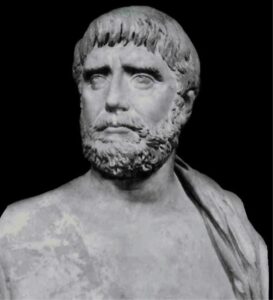
According to Herodotus, Thales was of Phoenician descent. He moved to southern Italy, where he founded a community of philosophers. The Greek scholar, Iamblichus, wrote that Thales made it clear to Pythagoras that he (Pythagoras) had to go to Memphis, in Egypt, to
study. Thales added that if the source of his knowledge came from his studies and tutelage under African masters in Egypt, Pythagoras could not afford not to go there.
Plato also records that Thales was educated in Egypt under the priests: “Thales was well and truly indebted to Egypt for his education.” The science of geometry was invented in Africa by
Africans, and Thales transferred the speculative science of geometry to Greece.
Socrates (469-399 BC): The Greek, Saint Clement of Alexandria, stated that: “If you were to write a book of 1,000 pages, you could not put down the names of all the Greeks who went to the Nile Valley in Ancient Egypt to be educated, and even those who did not go claim they went because it was prestigious”.
Socrates lived in Athens and wrote nothing himself, he was interested in ethics. It was his axiom that no one would knowingly do a bad thing. To him, knowledge was important because it resulted in good behaviour. Yet, through his pupil Plato, Socrates has influenced the entire history of Western thought, culture and morality.
He travelled to Africa for his early education and was the most spiritually inclined amongst the Greek philosophers that came to Africa. He was falsely accused and condemned to death at 70 years of age (by drinking a cup of hemlock), for “corrupting the youth of Athens”.
While awaiting condemnation in prison, he admitted to his pupils that he plagiarised (if not word for word) the work of the African philosopher, Esop, the Ethiopian (560 BC). Socrates confessed: “I availed myself of some of Aesop’s fables which were ready to hand and familiar to me and I versified the first of them that suggested themselves.”
Socrates is credited with the axiom: “Man know thyself” (in Greek Hellenic language, “qnothi seauton”). The truth is that the original glory of these words was already written by ancient Africans on the outside walls of temples some 2,000 years before Socrates came to learn the spiritual import. He stayed for over 10 years in Africa, according to his own biography.
Plato (428-347 BC). He was one of Socrates’ pupils and many of his writings (called “dialogues”) contained conversations with Socrates. Plato’s most famous work, The Republic, was chiefly concerned with the best form of life for men and states. He died aged 81 and was buried in Athens at the Academy, a school which he founded. Most of his doctrines are eclectic and point to an Ancient Egyptian source.
He copied his so-called four virtues – wisdom, justice, courage and temperance – from the original Ancient Egyptian spiritual belief system which contained 10 virtues. The Greeks renamed this belief system the “Mystery System”. After the death of Socrates, Plato left for Egypt where he studied for a period of 13 years. His mentor was Sechnuphis (or Snefuru), a scholar and philosopher priest of Anu (Heliopolis).
Strabo, the Greek historian who latter travelled through Egypt, states that his “Egyptian guide showed him where Plato had lived, it was how Plato learned the Fable of Thoth (Djehuti – the African god of wisdom, and sacred text) and Amun, which he wrote down in Phaedros.”
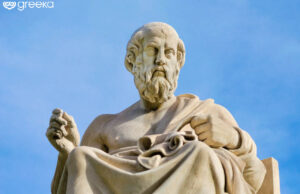
Pythagoras (582-500 BC). Like his contemporaries, this native of Samos journeyed in his youth to Egypt where he studied for almost 15 years. He travelled to Egypt for the purpose of education, and took advantage of the friendship between his fellow Greek Polycrates and Pharaoh Amasis. Polycrates gave Pythagoras a letter of introduction to Pharaoh Amasis.
He pursued studies in astronomy, geometry, and theology under the tutelage of Egyptian priests. However, more than 1,000 years before him, the Ancient Egyptians had correctly calculated the areas of rectangles, triangles, isosceles, and trapeziums. The area of a circle had also been obtained accurately.
Iamblichus, a fellow Greek philosopher, recorded in The Life of Pythagoras: “Thales laying stress on his advanced age and the infirmities of the body, advised [Pythagoras] to go to Egypt to get in touch with the priests of Memphis. Thales confessed that the instruction of these priests was the source of his own reputation for wisdom, while neither his own endowments nor achievement equaled those which were evident in Pythagoras. Thales insisted that, in view of all this, he [Pythagoras] should study with those priests, he was certain of becoming the wisest and most divine.”
The Pythagorean Theorem: This is a theorem stating that the square of the hypotenuse of a right-angled triangle is equal to the sum of the squares of the other two sides. Pythagoras travelled to Africa and was taught geometry by his African teachers (the high priests) and was shown the proof of the theorem of the square on the hypotenuse of a right-angled triangle. Africans had been using this principle for over 1,000 years before Pythagoras set foot on the continent. He did not discover this proof, and it is therefore misleading to name the theorem after him (see Herodotus, Bk III, Diogenes, BK VII).
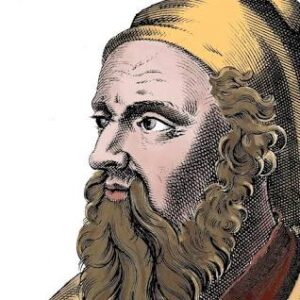
Aristotle (385-322 BC). A pupil of Plato’s, Aristotle was born in Thracia and joined Plato’s Academy at the age of 18. After Plato’s death, Aristotle left Athens and was afterwards invited by Philip of Macedonia to be a tutor to his son Alexander (who became Alexander the Great).
Years later, Aristotle returned to Athens to establish a rival school, the Lyceum, where he laid the foundations of various sciences including biology and zoology. Aristotle’s works include metaphysics and ethics. His main works are in Prior Analytics (in which he described the rules of logic), Physics, Animal History, Rhetorics, Poetics, Metaphysics, Nicomachean Ethics, and Politics.
Considered by modern Western scholars as the most influential philosopher of all ages and the founder of modern science, Aristotle is said to have spent over 20 years as a pupil under Plato. He accompanied Alexander the Great when he invaded and conquered Egypt and
helped himself to the libraries of all the major cities of Ancient Egypt. He is credited with writing 1,000 books on different subjects, a sheer impossibility for any individual in a lifetime.
The Unmoved Mover (proton kinoun akineton): This doctrine, like the many others that the Greeks appropriated, has been ascribed to Aristotle where he proves the existence of God. But according to Dr George James in Stolen Legacy, the “Unmoved Mover” is the essential thrust of the sacred African text recorded in The Memphite Theology, thousands of years before Aristotle was born. It is the first recorded story of the creation known in the world, now kept in the British Museum.
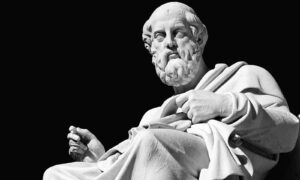
During the reign of Pharaoh Shabaka, the Nubian king, he ordered a copy of this story to be recorded on a slab, referred to as the “Shabaka Stone”. It is from this theology that Aristotle derived and plagiarised his concept of the “Unmoved Mover”.
The Memphite Theology is an authoritative African statement that contains the cosmology, theology and philosophy of the Ancient Egyptians (older than any religious text in the history of humanity) and should form the basis of classic African philosophy and be taught in our universities, not the carbon copies from Greece and elsewhere.
The achievements of the African forebears regarding the advancement of humanity need to be reclaimed, for they underscore how the world measures and values Africans. Hence they say we are Bantus, not Ancient Egyptians!
Leave a Reply