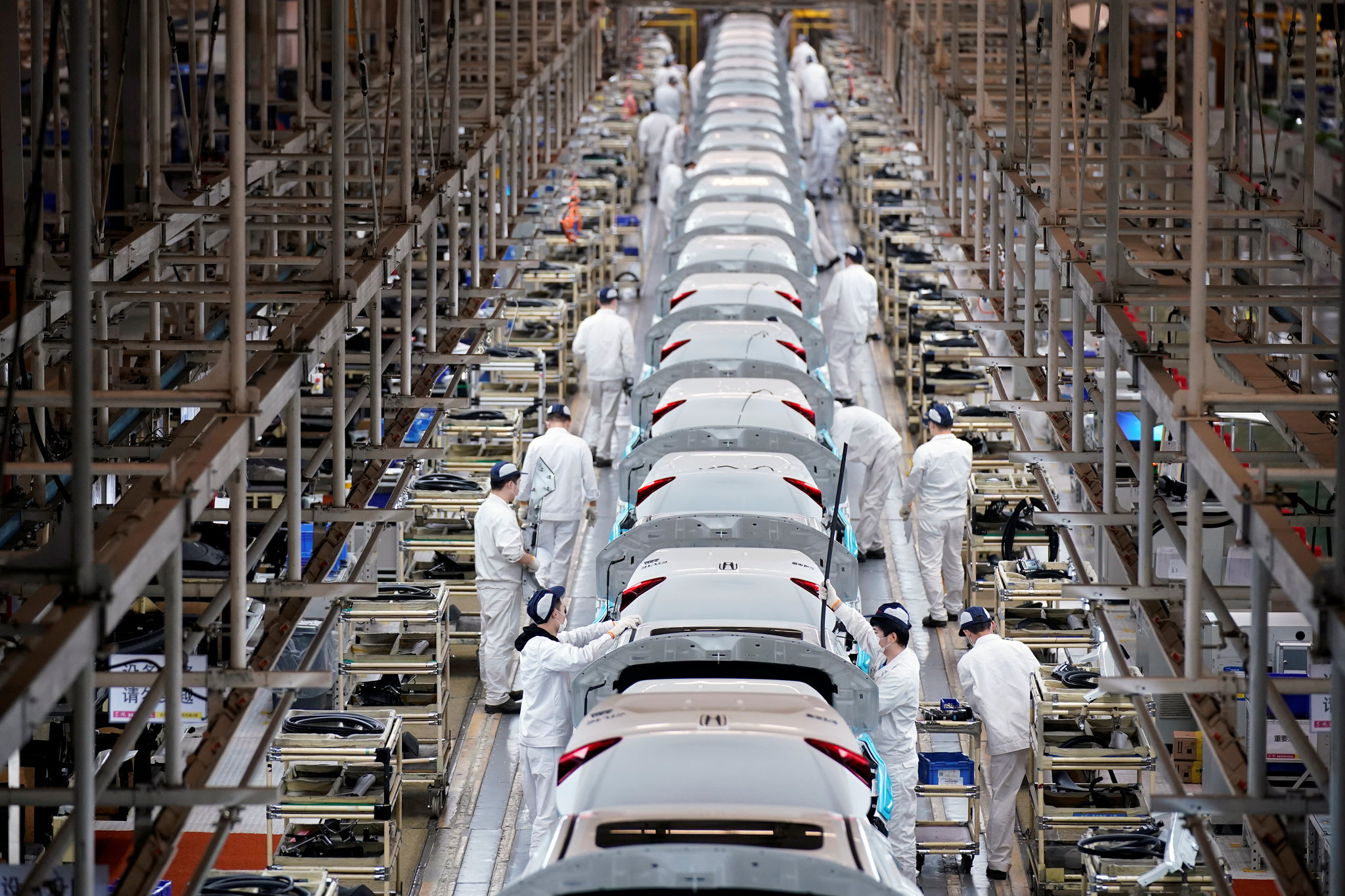
For centuries, state intervention has been at the core of wealth creation and economic success stories worldwide, starting with Britain and Europe in the late 15th century, carrying through to the USA in the 19th century, and Japan, Taiwan, South Korea, and Malaysia in the 20th century, and now China and India in the 21st century, reports Osei Boateng.
In recent decades, Africa and other developing countries have been encouraged to jump into free trade agreements with industrialised economies because it is supposedly the only way to grow the African economies. But Prof Ha-Joon Chang tells how all of today’s rich countries used nationalistic policies (tariffs, subsidies, restrictions on foreign investment, etc) to protect and promote their infant industries.
The story was the same with the more recent economic success stories of China and, increasingly, India. Their examples, according to Chang, “show the importance of strategic, rather than unconditional, integration with the global economy based on a nationalistic vision”.
Below is what the other nations did:
China
Like the USA in the mid-19th century, or Japan and South Korea in the mid-20th century, China used high import tariffs to build up its industrial base. Right up to the 1990s, China’s average tariff was over 30%. Chang admits that China has been more welcoming to foreign investment than Japan or South Korea were, but China still imposed foreign ownership ceilings and local content requirements that demanded that foreign firms should buy a certain proportion of their inputs from local suppliers.
Contrary to the liberalisation theory and the hands-off-by-the-state sermons preached to Africa, China has used heavy state intervention and an enlightened state-owned enterprise (SoE) strategy to grow its economy to a point where it is now an economic superpower vying for global domination with the more established economies like America’s. In the past, all Chinese industrial enterprises were owned by the state, but today, the SoE sector accounts for 40% of industrial output.
France
After the Second World War, the French government acknowledged that its conservative, hands-off policies had been partly responsible for its relative economic decline, and thus defeats in two world wars. To stem the tide, the French state decided to take a much more active role in the economy. It launched “indicative” planning and took over key industries through nationalisation, and channeled investment into strategic industries through state-owned banks.
To help its new industries to grow, the government imposed industrial tariffs and maintained them at a relatively high level until the 1960s. The strategy worked. By the 1980s, France had transformed itself into a technological leader in many areas.
Japan
In Japan, the Ministry of International Trade and Industry orchestrated an industrial development programme that has now become legendary. The country’s industrial tariffs were not particularly high after the Second World War, but imports were tightly controlled through government measures restricting the use of foreign exchange.
“Exports were promoted in order to maximise the supply of foreign currency needed to buy better technology (either by buying machinery or by paying for technology licences),” says Chang. “This involved direct and indirect subsidies as well as information and marketing help from the Japan External Trade Organisation, the state trading agency.
The government also put subsidised credits into key sectors through its “directed credit programme” while heavily regulating foreign investment by transnational corporations. Foreign investment was simply banned in most key industries. Even when it was allowed, there were strict ceilings on foreign ownership, usually a maximum of 49%. This brings into focus Zimbabwe’s now abandoned indigenisation policy which sought to limit foreign ownership of companies to a maximum 49%, with the remaining 51% going to indigenous entrepreneurs.
As Chang snows, foreign companies in Japan were required to transfer technology and buy specified proportions of their inputs locally. The government regulated the inflow of technologies, to make sure that overly obsolete or over-priced technologies were not imported.
Finland, Norway, Italy, Austria
Finland, Norway, Italy, and Austria were all relatively economically backward at the end of the Second World War and saw the need for rapid industrial development, says Chang. Basically, they all used strategies similar to those used by France and Japan to promote their industries.
All of them had relatively high tariffs until the 1960s. They all also actively used state-owned enterprises to upgrade their industries. This was particularly successful in Finland and Norway.
Also, the governments of Austria, Finland and Norway were very much involved in directing the flow of credit to strategic industries. Finland, especially, heavily controlled foreign investment while in many parts of Italy, local governments provided support for marketing and Research and Development (R&D) to small and medium-sized firms in their localities.
“In Finland”, Chang says, “it took Nokia 17 years to earn any profit from its electronics subsidiary, which [by 2011 had become] the largest mobile phone company in the world. If Finland had liberalised foreign investments from early on, Nokia would not be what it is today.”
United States of America
America’s trade policy recommendations to the developing world today stand in sharp contrast to what it did itself when it was a British colony and as a young, independent country. According to Chang, the USA had a terrible record in its dealings with foreign investors.
From its earliest days of economic development right up to the First World War, the USA was the world’s largest importer of foreign capital, but there was considerable concern in the country over absentee management of foreign investors. “Reflecting such sentiment, the US federal government strongly regulated foreign investment.” Chang reports. “Non-resident shareholders could not vote and only American citizens could become directors in a national (as opposed to state-level) bank.”
This meant that foreigners and foreign financial institutions could only buy shares in US national banks if they were prepared to have American citizens as their representatives on the board of directors, thus discouraging foreign investment in the banking sector.
There were also strict regulations on foreign investment in natural resource industries. Many state governments barred or restricted investment by non-resident foreigners in land. Then the 1887 federal Alien Property Act was enacted to prohibit the ownership of land by foreigners – or by companies more than 20% owned by foreigners – in the “territories” (as opposed to the fully-ledged states) where land speculation was particularly rampant.
Federal mining laws also restricted mining rights to non-US citizens and companies incorporated in the USA. In 1878, a timber law was also brought in, permitting only US residents to log on public land.
“Yet,” says Chang, “despite all these excessive, and often strict, controls on foreign investment, the USA was yet the largest recipient of foreign investment throughout the 19th century and the early 20th century – in the same way that strict regulation of transnational corporations in China has not prevented a large amount of foreign direct investment from pouring into that country in recent decades. This flies in the face of the belief that foreign investment regulation is bound to reduce investment flows.”
Singapore
The economic prowess of the island city-state of Singapore is trumpeted as a victory for liberal, free market ideas. But even in Singapore, state intervention is not too far away. For example, Singapore Airlines, one of the world’s best, is a state-owned enterprise, 57% controlled by Temasek, the holding company whose sole shareholder is Singapore’s Ministry of Finance.
“Virtually all land in Singapore is publicly owned, and around 85% of housing is provided by the government’s Housing Development Board,” says Chang. “The Economic Development Board also develops industrial estates, incubates new firms, and provides business consulting services.”
In fact, Singapore’s state-owned enterprises sector is twice as big as that of South Korea, when measured in terms of its contribution to national output.
Taiwan
One of the economic successes of the past 60 years, Taiwan’s experience with state-owned enterprises has been even more remarkable. Taiwan’s official economic ideology is based on the “Three People’s Principles of Dr Sun Yat-Sen, the founder of the Nationalist Party (Koumintang) that engineered the Taiwanese economic miracle. These principles dictate that the key industries should be owned by the state. Accordingly, Taiwan has had a very large state-owned enterprises sector.
For Africa, whose governments are often told or advised to keep their hands off the economy (“private sector development” is the engine of growth), the above should provide ample food for thought.
Leave a Reply