… NATO wanted to use it as a springboard against Russia
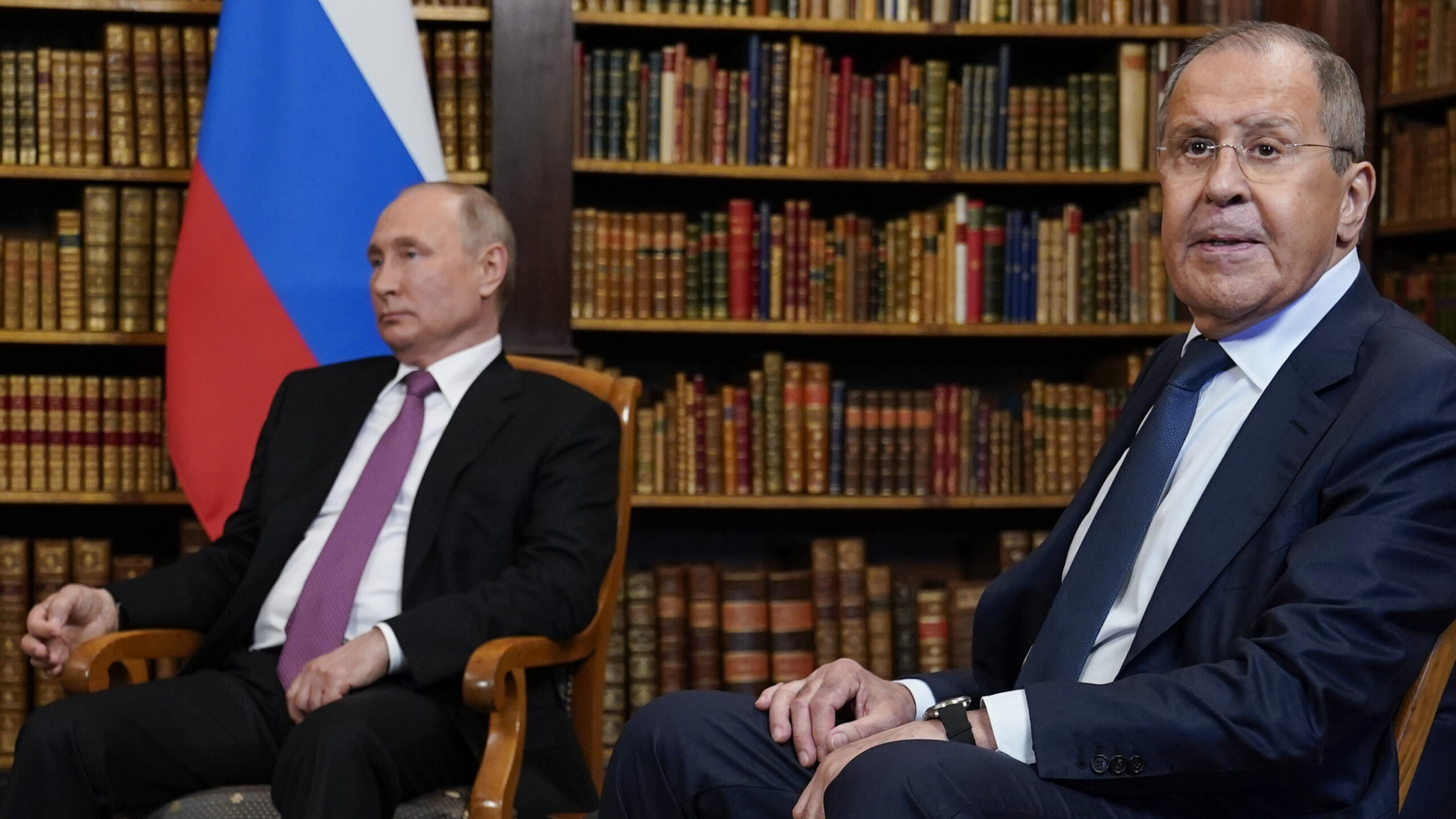
Russia’s foreign minister, Sergey Lavrov, explains in a major interview with the India Today TV channel why his country had to go to war in Ukraine, starting on 24 February 2022. He told Geeta Mohan who interviewed him: “Of course, [the war is] linked with Ukraine becoming a NATO springboard and a NATO expansion. They were saying Ukraine will be in NATO and nobody can stop it if it so wishes. And then President Zelensky said Ukraine might think about possessing nuclear weapons.” About Russia’s desire to de-dollarise the energy sector, Lavrov said it was to stop the European Union countries from “stealing” from Russia and to provide an “insurance that this robbery will not happen again”.
Q: What is the reason for President Putin to take Russia to war when negotiations were taking place?
A: The real reason is the complacency of most countries in the word, after the end of World War II, when our Western colleagues led by the United States declared themselves the winners and in violation of their promises to the Soviet and Russian leadership, started moving NATO eastwards.
They kept saying “don’t worry, this is a defensive alliance, it is not a threat to Russian security”. But a defensive alliance it was when there was NATO and the Warsaw Treaty, and there was the Berlin Wall, as you remember, both physical and geopolitical, and it was very clear what was the line of defence for these defensive alliances.
When both the Warsaw Treaty and the Soviet Union disappeared, they decided that they would move the line of defence eastwards and they did this five times without explaining against whom they were going to defend themselves, but in the process building their advance and assault capabilities, and choosing the former Soviet republics, especially Ukraine, as the springboard against Russian interest.
As early as 2003, for example, when Ukraine had another presidential election, the West publicly and bluntly demanded from the Ukrainians, “you must choose whether you are standing with Russia or with Europe”. And then of course, they started pulling Ukraine into an European Union association agreement which asked for zero tariff for Ukraine goods going into Europe and European goods coming into Ukraine.
We [Russia] did have a free trade agreement with Ukraine in the context of the Commonwealth of Independent States. So we told our Ukrainian neighbours, “guys, we have a zero tariff agreement with you but we have protection from the European Union because we negotiated for double entry for 80 years, and we did manage to protect [our goods] with considerable tariffs for a period of time”. Some sectors of the Russian economy had agreed on insurance, banking and others. So we told the Ukrainians, “if you have zero tariff with Europe and have zero tariff with us, we are not protected against European goods. It was part of the deal when we entered into double agreement.”
Then the Ukrainian president in 2013, [Viktor Yanukovych] understood the problem. He asked the European Union to postpone the signature of the association agreement, and we suggested that the three of us – Russia, Ukraine and the EU – could sit together and discuss how to press ahead. The European Union in a very arrogant way said, “this is none of your business, we don’t put our noses in your trade with China and with other countries, so this is going to happen.”
Then the president of Ukraine, [Viktor Yanukovych] decided to postpone this ceremony, and next morning there were demonstrators all over the Ukraine, capital, Kyiv, and other cities. So they started the protests in early December 2013, and it culminated in some bloody events in February 2014, and the European Union failed to negotiate a deal between President Yanukovych and the opposition.
Next morning, representatives of the EU – France, Germany and Poland – were absolutely ignored by the opposition [led by ] who staged the coup and declared that they were forming a government of the winners, and they will cancel the special status of the Russian language, and they threatened to throw the Russian ethnic group away from Crimea, and formed groups to storm the Crimean parliament.
That is how the war started in Crimea when the Crimeans said, “we don’t want to have anything to do with you, leave us alone”. They came under the threat of the armed groups. They called for a referendum and the eastern areas of Ukraine [the Russian-speaking Donetsk and Luhansk] said “guys, we don’t support your coup, leave us alone”. They [Donetsk and Luhansk] never attacked the rest of Ukraine. The putschists attacked them, and they called them terrorists. They called them terrorists for a long eight years.
======
Third Eye note: For readers to fully understand what Sergey Lavrov is saying, the following is the background. According to the World Socialist Website: “The background and implications of the 2014 far-right coup in Kyiv, which overthrew the pro-Russian President Viktor Yanukovych, is critical for understanding the current Ukraine-Russia war. This coup was openly supported by US and European imperialism and implemented primarily by far-right shock troops such as the Right Sector and the neo-Nazi Svoboda Party.
“It represented the temporary culmination of long-standing efforts by US and Western imperialism to install a puppet regime on the borders of Russia … Ukraine has since been systematically built up as a launching pad for a NATO war against Russia.
“The regime change prompted the outbreak of an ongoing civil war in the east of Ukraine, between Russian-backed separatists [in the self-proclaimed republics of Donetsk and Luhansk] and the US-backed Ukrainian army, that has claimed the lives of tens of thousands and displaced millions.
“For the first time since 1945, an avowedly anti-Semitic, pro-Nazi party controls key levers of state power in a European capital, courtesy of US and European imperialism. After the coup of February 2014, the unelected Ukrainian government, headed by the US appointee, Arseniy Yatsenyuk, included no fewer than six ministers from the fascist Svoboda party.”
In 2013, the World Jewish Congress called for Svoboda to be banned. But the party’s founder and leader, Oleh Tyahnybok, who had spoken repeatedly of his determination to crush the “Russkie-Yid mafia that controls Ukraine,” was feted by US and European Union officials as they prepared the February 2014 coup in Ukraine.
se was the major political force in the so-called Maidan protests that overthrew Ukrainian president Viktor Yanukovych. In return for providing the shock troops for the coup, Svoboda has been given control of vital ministries.
Svoboda’s co-founder Andriy Parubiy acted as “security commandant” in the protests, directing attacks by the Right Sector – an alliance of fascists and extreme rightwing nationalists. Dressed in uniforms modelled on Hitler’s Waffen SS, its members boast of fighting Russia in Chechnya, Georgia and Afghanistan.
One of the first acts of the new government after the February 2014 coup was to abolish minority rights for Russian-speakers. “This is the real record of the reactionary forces that the imperialist powers are aiding and abetting in Ukraine, and on whose behalf they are prepared to plunge Europe, and indeed, the entire world, into a Third World War,” Julie Hyland wrote in a 6 March 2014 article.
In another major article published on 21 January 2022, a month before Russia attacked Ukraine, Peter Schwarz warned: “State commemorations and public memorials to war criminals, mass murderers, anti-Semites and Nazi collaborators such as Symon Petliura, Stepan Bandera and Roman Shukhevych.
“The integration of fascist militias into the official armed forces and the networking and military training of neo-Nazis from all over the world under the protective hand of the state. Mafia-like struggles for state power between a handful of oligarchs and a corrupt judiciary and authorities. Screaming social inequality with an average monthly income of 412 euros (April 2021). These are the most salient features of Ukrainian “democracy”, for which the US and its European NATO allies are risking war against the nuclear power Russia.”
Schwarz continued: “‘Now, as ever, it is up to Ukrainians and no one else to decide their own future and the future of this country’, US secretary of state Antony Blinken said on 19 January 2022 during a visit to Kyiv. ‘The Ukrainian people chose a democratic and European path in 1991. They took to the Maidan to defend that choice in 2013. And unfortunately, ever since, you’ve faced relentless aggression from Moscow. Russia invaded territory in the Crimea, ginned up a conflict in eastern Ukraine, and has systematically sought to undermine and divide Ukraine’s democracy.’ Similar expressions are coming from the capitals of Europe. But every single word of Blinken’s statement is a lie.”
Schwarz went on: “Contrary to what Blinken claims, the events on the Maidan were not a choice for democracy, but a right-wing coup. The elected president, Yanukovych, who had been manouevring between Russia and the Western powers, was hounded out of office with the help of fascist militias and with the open support of Washington and Berlin and replaced by Petro Poroshenko.
“Victoria Nuland, then Assistant Secretary of State for European and Eurasian Affairs and now number three in the US State Department, personally paraded on the Maidan to cheer on the protests against Yanukovych. She publicly. boasted that the US had invested five billion dollars in regime change in Ukraine.
“Germany’s social democratic president, Frank-Walter Steinmeier, then still foreign minister, also travelled to Kyiv to negotiate Yanukovych’s replacement with the opposition parties and Yanukovych himself. He worked directly with Oleh Tyahnybok, the leader of the fascist Svoboda party,” Peter Schwarz added.
The ink on Steinmeier’s agreement was barely dry when Right Sector, a neo-fascist militia, seized the centre of Kyiv and drove Yanukovych, who feared for his life, to flee.
Since then, fascist militias have been an integral part of Ukraine’s political life. They terrorised political opponents and kept the war in the east against the pro-Russian separatists in Donetsk and Luhansk, until Russia invaded Ukraine in February 2022.
A key role among the 80 or so far-right militias built and equipped to fight the Donetsk and Luhansk separatists is played by the Azov Regiment. Founded by Andriy Biletsky, who was freed from prison during the events on the Maidan, where he was serving a sentence for murder, the Azov Regiment has never made a secret of its admiration for the Nazis.
Biletsky professed his support for the “crusade of the white nations of the world against the Semitic-led subhumans”. The Azov Regiment’s symbols – wolf’s hook and black sun – were used by Hitler’s SS in World War II.
Nevertheless, Azov was financed and equipped by the Ukraine state and its oligarchs. President Poroshenko praised them at an awards ceremony in 2014, declaring, “These are our best warriors.” Biletsky was celebrated on TV talk shows and elected to parliament in 2014. Eventually, Azov was officially integrated into the Ukrainian armed forces, where it forms its own regiment.
But Azov is far more than a militia. “It has its own political party; two publishing houses; summer camps for children; and a vigilante force known as the National Militia, which patrols the streets of Ukrainian cities alongside the police.” Its military wing has “at least two training bases and a vast arsenal of weapons, from drones and armoured vehicles to artillery pieces.”
Azov’s political wing, the National Corps party, claims to have around 10,000 members and maintains intensive relations with fascist and neo-Nazi organisations around the world
Despite all this, the USA has been supplying the Ukrainian armed forces and militias with weapons and trainers for years, knowing full well that fascist militias benefit from this. When President Barack Obama signed legislation to this effect in 2015, it explicitly did not exclude financial and military support for the Azov Regiment, although this had been widely expected.
The preparations for war against Russia and the build-up of fascist militias were two sides of the same development in Ukraine. In a 10 July 2021 article, Johannes Stern disclosed that “since the United States and Germany backed the fascist-led coup in Ukraine in February 2014, the imperialist powers have continuously intensified their pro-war offensive against Russia.
“The imperialist-backed regime in Kyiv is demanding Ukrainian membership in NATO and planning a military offensive to reassert control over the Donbass and ‘retake’ Crimea.”
Then entered the current president, Volodymyr Zelensky, into the fray in 2019. Born on 25 January 1978, Zelensky, a former comedian of Jewish extraction, became the sixth and current president of Ukraine after he won the 2019 presidential election (held on 31 March and 21 April in a two-round system) on an anti-corruption ticket, supported by the fourth richest Ukrainian, Ihor Kolomoyskyi (net worth $1.8 billion).
Born to a Jewish family, Zelensky grew up as a native Russian speaker in central Ukraine. Before his acting career, he obtained a degree in law from the Kyiv National Economic University. He then pursued a career in comedy and created the production company, Kyartai 95, which produced films, cartoons, and TV shows, including the TV series, Servant of the People, in which Zelensky played the role of the Ukrainian president.
The series aired from 2015 to 2019 and was immensely popular, which helped launch Zelensky in a real-life pursuit of the presidency. He and the employees of Kyartai formed a political party bearing the same name as the TV series in March 2018. Zelensky won the second round of the 2019 presidential election by 73.23% of the vote, defeating the then president, Petro Poroshenko.
Unfortunately, Zelensky, turning very pro-Western, was not able to mollify the Moscow-backed separatists who have controlled the southeastern Ukrainian regions of Donetsk and Luhansk, known collectively as Donbass, since 2014.
Interestingly, the Russian president, Vladimir Putin, only officially recognised Donetsk and Luhansk as independent republics on 21 February 2022 (three days before Russia’s invasion of Ukraine), paving the way for the official presence of Russian troops in the rebel-controlled areas that occupy about a third of Donetsk and Luhansk.
This is the long background to what Sergey Lavrov is saying in the India Today interview, which continues below:
============
We [Russia] managed to stop this bloodshed [unleashed by the Ukrainian army and its supporting militias against the citizens of Donetsk and Luhansk] in February 2015. The so-called Minsk Agreement was signed, providing eastern Ukraine some special status, giving them the right to have some local police, special economic relations with the adjacent Russian regions, basically the same as the European Union negotiated for the north of Kosovo. But in both cases, the European Union failed totally to deliver on what was guaranteed by the signatures of its members.
And for eight long years, the respective governments and presidents of Ukraine bluntly and publicly said that they would not implement the Minsk Agreements, and that they would move to Plan B. So they continued to shell the territories of the proclaimed republics in all these years, and we [Russia] warned the Europeans, the Americans, and the Ukrainian government that they were ignoring something which was endorsed by the United Nations Security Council, to no avail.
My last point, I understand that people don’t want to go back into this history because they prefer to take events on the immediate merit, but the events, indeed this particular event is rooted in the desire of the United States and what we call the “Collective West” to rule, to dominate the world, and to just show to everybody that there will be no multipolarity, it will be only unipolarity, and that they can declare Iraq, Syria, Libya, Yugoslavia, located 10,000 miles from the United States threats to their security and can do whatever they please there, levelling the cities like they did in Mosul in Iraq and in Syria.
But when Russia is warning all its colleagues that just on our borders you have been creating a springboard against us, you have been pumping arms into Ukraine, you have been totally ignoring the legislation of Ukraine which completely prohibited the Russian language, you have been ignoring legislation which has been encouraging neo-Nazi ideology and practices, and neo-Nazi battalions which were marshalled against the territories that proclaimed themselves independent and who were promised special status inside Ukraine.
Of course, the very latest development [the Russian attack on Ukraine] was all linked with Ukraine becoming a NATO springboard and a NATO expansion. They were saying Ukraine will be in NATO and nobody can stop Ukraine if it so wishes. And then President Zelensky said he might think about coming back to possess nuclear weapons.
And in November last year my president [Putin] suggested to the United States and NATO to sit down with Russia, to cool off, and to discuss how we can agree on security guarantees, without further expansion of NATO eastwards. They refused.
In the process, the Ukrainian army radically intensified the shelling of [Donetsk and Luhansk] in violation of four ceasefire agreements. They didn’t have any other choice but to recognise [Donetsk and Luhansk], to sign mutual assistance treaties with them, and in response to the request [of Donetsk and Luhansk] to send our troops as part of the special operation [the war in Ukraine] to protect their lives.
Q: You have provided the basis, history as well as the current context to the war in Ukraine. President Putin himself has said this is not about the people of Ukraine, it is about the administration. We know that in international relations, there is something called “not in my backyard”, which is used often by America and other countries. But should an entire people be punished for an administration wanting to carry out an independent foreign policy?
A: I don’t think it is about any independence. Since 2013 and even earlier, hundreds and hundreds of American, UK and other Western security and military experts have been openly sitting in the Ukrainian ministry of defence and the Ukrainian security apparatus and they were basically running the place.
As for the civilians, immediately when this special operation in response of a request from Donetsk and Luhansk, for full compliance of Article 51 of the United Nations Charter, when the special operation was announced by President Putin, he said that the sole purpose of this operation was to demilitarise and de-Nazify Ukraine, because these are two intimately-linked problems in the country, and we have been targeting only military infrastructure.
Unfortunately, the Ukrainian army and the so-called nationalist battalions who are using Nazi insignia, swastika which was borrowed from Indian history but twisted the wrong way and the insignias of Waffen SS, which these people were using and continue to use – the Ukrainian army and the nationalist battalions use civilians as a human shield, and they placed heavy weapons in the middle of the towns and cities, next to schools, next to kindergartens, and hospitals. The internet is full with the testimonies of the people who were leading in those places and who were asking the Ukrainian army and the Nazi militias not to do this.
Unfortunately, nobody in the West actually pays attention to the facts which we have been providing. Instead they are staging fake incidents like a couple of weeks ago in a place called Bucha where when the Russian troops left, on 30 March, the city was back in the hands of the Ukrainian administration. The mayor of Bucha publicly said that “we are back, the city is back to normal life”, but on the fourth day they started showing images of dozens of corpses lying in the streets, in a city which only three days before had been shown to be back to normalcy.
And then a few days later in the city of Kramatorsk, which was fully in Ukranian hands, they summoned people to the railway station and used a missile and it was proven beyond any doubt that the missile was fired by the Ukrainian army. Next morning it was out in the news, in the West, because the obvious nature of this provocation was understood by everybody. The New York Times then said they had the proof that the cluster bombs were used by the Ukrainian army.
So speaking of civilians and the rules of international humanitarian law, I can once again assure you that our army has been targetting military infrastructure and not civilians.
Q: Despite what you have just said, about the Ukrainian army putting tanks and heavy weapons in civilian areas, the Russian army has not shown restraint by taking them down, and as a result there has been civilian bloodshed. Will some responsibility be taken also by Russia on the bloodshed?
A: It is terrible when military activities bring damage to the civilian sector and civilian infrastructure. As I said the Ukrainian army and its Nazi militias had been killing ethnic Russians, citizens of Ukraine, in the east, for 8 years without any TV representatives, be they Asian, African, Latin-American, European, or American paying any attention to this.
But when Russian journalists, working 24/7 from the republican side, showing the atrocities committed by the Ukrainian neo-Nazis and armed forces during all those eight years, no single foreign journalist cared to come to the [self-proclaimed republics] to see what was going on. The statistics available indicate that the damage inflicted on the civilians and the civilian infrastructure, on the side of the republics, were five times more and bigger than the figure for the territory controlled by the Ukrainian government.
This is not to say that we can just ignore the victims and the damage to the civilian infrastructure, but once again I want to emphasis a very important thing that this outcry started only when the Russians decided to protect Russians who are citizens of Ukraine and who were absolutely discriminated against.
There was no outcry when [Iraqi cities] were levelled with dozens of tanks and hundreds of corpses lying in the streets unattended for weeks and weeks. The American military never have any scruples of achieving their military goals, be it in Syria, Iraq, or Afghanistan for that matter.
It is a tragedy that people die, but we can’t tolerate the situation where our Western colleagues say that “we can do anything we want and we can encourage the government in Kyiv to be as Russo-phobic as it takes. We will not tell them to stop prohibiting the Russian language in education and in the media, we will not tell them not to ban all Russian-speaking channels, including Ukrainian channels. We will not tell them not to persecute the people in the eastern republics, we will not tell them to have dialogue with Russia, and we will not tell them to stop violating their commitments to give special status to the territories in the east where the Russian-speaking population dominates”.
Q: On the allegations against Russia on genocide and chemical weapons having been used by Russian forces, what do you have to say?
A: There is a special commission created in Russia, a public organisation which is very experienced, they have been discovering the fakes staged by the so-called white helmets in Syria and in many other cases. We will not cease our efforts to establish the truth.
We are used to the fact that the United States, the United Kingdom and other Western countries have a very interesting habit, they just throw in the news things they believe are for their benefit ideologically. And then when it comes to facts, and when the facts are discovered that puts a question mark on their assertions, they just lose interest.
In 2007, in London, the poisoning of [Alexander] Litvinenko, huge outcry, the trial begins and after a few weeks, it is made public which in the UK means secret. Unfortunately, until now we cannot get the facts about what actually happened to Mr Litvinenko.
In 2014, the Malaysian Airlines Boeing that was shot down over Ukraine, we presented a huge amount of facts and requested that we be part of the investigation. No way. Though the Ukrainians did not close the skies during the conflict, they were invited to join the investigation, but Russia was not. Malaysia, as the owner of the plan, was invited to join the investigation only five months later, after the Australians, the Dutch and the Malaysians agreed among themselves that anything coming out of the investigation must be subject to consensus, meaning Ukraine which did not close the skies had a veto power over this investigation. So we could not get the truth on this one as well.
In 2019, Skripal poisoning, the people disappeared. [Seigei Skripal and his daughter Yulia were alleged to have been poisoned with the nerve agent novichok in Salisbury, UK, and Britain accused Russia of having done it, leading to Britain and its Western allies expelling scores of Russian diplomats from their countries. Russia retaliated by expelling a similar number of British and Western diplomats].
The only proof which was made public was a “highly likely” comment by Theresa May [the then British prime minister]. Yet the Brits insisted on the expulsion of Russian diplomats, and most European countries followed suit. And when I ask my Western friends, “did you provide proof beyond the public statements of ‘highly likely’”? They say no. But they promised to. I checked one year later if this was done. It was not done.
In 2020, our opposition blogger, Alexei Navalny was poisoned. [He was taken ill on a domestic flight to Moscow, the Russian capital, and after a German request, Russian doctors agreed to transfer him to Germany for medical treatment].
We immediately responded to the German request to let him go to the Berlin hospital. Twenty-four hours after the request, he was flown to Berlin. We don’t have any confirmation who was flying with him [on the domestic flight to Moscow], where did they get the bottle which was the key element in this investigation, and when we asked the Germans to show us the formula that they discovered in his body, they said this is military secret.
It is us, until now, who insist on Litvinenko, who insist on the Skripals, who insist to know about the Malaysian Boeing, and about Navalny. The stories which they have staged in Ukraine are from the same nature.
Q: The neo-Nazis in Ukraine should not have been incorporated in any military organisation in any country, but would you introspect and look at your own people as well. Will there be an investigation against your own [troops] if they have done wrong? Will they be held accountable?
A: We have our law which prohibits the military to do anything that is not allowed under international humanitarian law. Any violations are absolutely registered and investigated.
On Azov, the neo-Nazi group in Ukraine, it was declared by the United Nations in 2014 to be a group that cannot be supported and cannot legitimately operate, and was prohibited by US Congress for any US administration to provide any assistance to this battalion. But everybody forgot about this, rather they sort of remember what this group was about and they decided to put their money on this group.
In Japan, the government passed a special decree that Azov was no longer a neo-Nazi group and the Japanese government apologised for listing Azov some time ago as such.
And, of course, President Zelensky, in his camouflage, was asked about Azov by a journalist who felt something was wrong with these neo-Nazi groups. Zelensky said Azov “are what they are. We have many groups like this. They are part of our army.”
The media only started asking questions about Azov only when the [Russian] military operation was in action. For the long eight years, nobody lifted a finger, nobody bothered about what was being groomed in Ukraine as probably a continuation or a resurrection of what was going on in Europe in the 1930s.
Q: President Zelensky says Russia plans to use tactical nuclear weapons…
A: [cuts in]. He says many things depending on what he drinks or smokes. He says many things.
Q: Was it a tactical mistake on the part of President Zelensky to take on the Russians when he had no real guarantees from the Americans and the Europeans that they would come to his aid?
A: President Zelensky came to power with the promise that he would achieve peace on the basis of the Minsk Agreements. However, a few months later, he said he could not implement the Minsk Agreements because the Agreements were un-implementable. He never said this was because of the military situation on the ground.
He said it was unthinkable for Ukraine to give any special status to any part of its territory. But it was very thinkable if I may say so, when Ukraine was created to put together territories which now in the west never celebrate the victory day, 9 May, and on the other hand the territories in the east which never celebrate the heroes that were honoured in the west, those who collaborated with Adolf Hitler.
So this difficult composition of territories, to now say that Ukraine can only be a unitary state, that “I will not give special status to these people even if the United Nations Security Council demands so”, I believe it was not very farsighted. Had he cooperated as he promised the electorate, when he was elected, if he had cooperated and implemented the Minsk Agreements, the crisis would have been over long ago.
Q: Is Russia playing Ukraine against Zelensky?
A: No, the West is playing Zelensky against Russia, and did everything to strengthen him in his desire to ignore the Minsk Agreements. The West in fact is a broad notion, but it is the United States and the Brits, the rest of the West including the European Union, is now just an obedient servant.
Q: Will Russia ever use tactical nuclear weapons in Ukraine?
A: That is the lie put out by Mr Zelensky. We never mentioned this. He mentioned it, so his intelligence must have provided him with some information. I cannot comment on something that an ineloquent person pronounces.
Q: Is nuclear on Russia’s table at all, in this conflict?
A: When the Soviet Union and the United States in 1987, Presidents Mikhail Gorbachev and Ronald Reagan, decided that they had special responsibility for peace on this planet, they signed a solemn declaration that there could be no winners in a nuclear war and therefore nuclear war must never be launched.
After the Trump administration came to office, we have been telling them because the tensions were aggravated and we said “why don’t we try to send a positive political message to the entire universe and to reiterate what Gorbachev and Reagan had pronounced”. But in the entire 4 years of the Trump administration, they refused to do so.
However, we were really encouraged when President Joe Biden was inaugurated. In fact, five days after his inauguration, we repeated this offer, and he first agreed to extend the Star Treaty without any preconditions, which the Trump administration was not ready to do. In June 2021 when Biden met with President Putin in Geneva, they issued a declaration on our initiative.
After that, the Americans and the Russians said there must be no nuclear war, they shouldn’t even think about it. We started to promote the same commitment in the context of the P5. Not the United States, not the UK, not France, it was Russia that pushed for it. Eventually in early January 2022, the P5, at the level of their presidents and heads of government, issued a statement that we initiated, and which we had been pushing for all these years. [The P5 refers to the United Nations Security Council’s five permanent member states – United States, UK, France, Russia, and China. It becomes the P5+1 with the inclusion of Germany].
Q: So nuclear is off the table, only as a last resort?
A: This statement, both the Russian and American statements, and the P5 summit statement, were issued on the strong insistence of the Russian Federation.
Q: It seems Ukraine has lost more land than they would have gained by negotiating on Donbass?
A: It’s the decision of those who have been running Ukraine, those who have been sabotaging the Minsk Agreements in spite of the UN Security Council decision. We are not up for a regime change in Ukraine, we have said this repeatedly.
We want the Ukrainians themselves to decide how they want to live first, in a way which will not repeat the Minsk Agreements, when [Donetsk and Luhansk] decided that they didn’t want to do anything with the coup leaders who immediately said they were against the Russian culture, language, and everything that the people of [Donetsk and Luhansk] cherish. And then they were promised something by the European Union but they were cheated. So we want the people to be free to decide how they want to live in Ukraine.
Q: Russia is one of the most sanctioned countries in the world, how long can you sustain it?
A: I don’t think we are thinking in the context of sustaining it. Sustaining means you take some hardships and hope that sooner than later, this will be over. The decisions which we have been taking during, not this particular conflict but for many years, because Russia has been under sanctions all along, so now we have come to a very straight forward conclusion: we cannot rely on our Western colleagues in any part of our lives which has strategic significance, be it for security which we managed to ensure ourselves after 2014, be it of course defence, and be it some strategic sectors where high-tech is developing and indicating for the future of mankind.
We did not have time to achieve self-sufficiency in all these areas but in most cases we have resolved these issues, and of course we are open to cooperation with all other countries who do not use illegal and illegitimate and unilateral measures in violation of the UN Charter.
Q: Finally, Europe is hoping to halt gas imports from Russia, but you are looking for the de-dollarisation of the global energy market by dealing in roubles. How do you propose to do that should they start halting gas imports from Russia?
A: There will be no change for the Europeans or the countries who buy our gas. The reason for this decision was very simple and obvious: when they froze the Russian assets in dollars and euros and yen and pound sterling for an amount of more than 300 billion euros, that was mostly the money kept in Western banks after we receive payment from the Western countries for our gas deliveries.
In other words, they paid us and they stole the money from us, because those were the currencies that are linked to the Western banking system. So what we told them to do is that they would not be paying directly to Gasprom accounts abroad, they would be paying to the Gasprom bank, which is an independent entity.
They would be paying the same amount which they have to pay under the existing contracts, but they will pay these amounts to special accounts which they have to open with the Gasprom bank. And there will be a parallel account in roubles. So they pay euros inside the bank, and the euros are transferred to the rouble account, and from this account Gasprom itself receives roubles.
Q: So you are not running losses at all on the money that Russia is receiving from Europe?
A: Exactly. As of now, they will not be able to keep the money in their banks, the money which they pay to us. I believe this is something which will not create conflicts. They will still be paying in euros or dollars or whatever was the currency of the contract, but we will have insurance that this robbery will not happen again.
Q: Will the war in eastern Ukraine continue and intensify?
A: The operation in the east of Ukraine is aimed, as it was announced in the very beginning, to fully liberate Donestk and Luhansk, and this operation will continue. Another stage of the operation is beginning and I am sure it will be a very important moment.
Leave a Reply