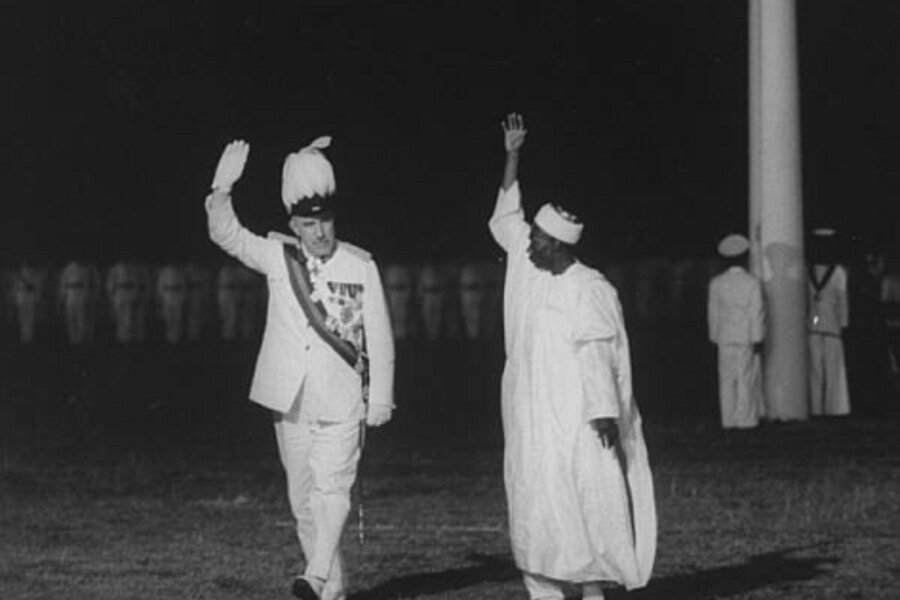
… It rigged Nigeria’s independence elections and set the country on a slippery slope ever since

(extreme right) seen here with his wife and the “stooge” that Britain left as prime minister of Nigeria, Sir Abubakar Tafawa
Balewa (left) to look after British interests after independence. They even knighted Balewa in January 1960, a whole 10 months
before Nigeria’s independence, and called him a “Sir”. They made him a “Knight Commander of the Order of the British
Empire”. The University of Sheffield gave him an honorary doctorate in May 1960, followed by the New York University which
also gave him an honorary doctorate of laws in May 1961. They know how to look after their “stooges”
Today, Britain goes around the world preaching against election malpractices. But in 1956 and 1959, Britain deliberately rigged Nigeria’s independence elections so that its favoured “friends” in the North would dominate the country after independence. On 13 April 2005, our editor Baffour Ankomah, then editor of the London-based New African magazine, went to interview one of the British colonial officers involved in the Nigerian affair, Harold Smith. “A Methodist, brought up to be decent, honest and obey the law” (his own words), Smith was the only British official in Nigeria at the time who would not do Whitehall’s bidding and rig the Nigerian independence elections. For that, he suffered for the rest of his life as he refused several inducements, including a “pot of money” and a knighthood to keep him quiet. Having refused those inducements, Smith was not allowed to work again in Britain (since 1960). He died in 2011. He believed that he was poisoned, and his phone constantly bugged. This is a story that shames London and makes its criticisms of other people’s elections sound very hypocritical. Baffour Ankomah reports.
Chimamanda Ngozi Adichie, one of the best novelists to come from Nigeria, writes in the preceding article: “Since the end of military rule in 1999, Nigerians have had little confidence in elections. To vote in a presidential election was to brace yourself for the inevitable aftermath: fraud. Elections would be rigged because elections were always rigged; the question was how badly. Sometimes voting felt like an inconsequential gesture as predetermined ‘winners’ were announced.”
Poor Chimamanda Adichie. “Elections would be rigged because elections were always rigged.” Yes. But it did not start “since the end of military rule in 1999”.
That is a serious misreading of the Nigerian situation.
Rigging of elections in Nigeria goes back to the very beginning of Nigeria’s independence in1960. And it was not started by Nigerians. It was started by the British colonial masters, in the 1956 and 1959 independence elections – because the British wanted their “friends” in the North who did not have the political nous to run the country, to yet win the elections and control the country. For what purpose? To look after British interests after independence.
And whatever that did to Nigeria’s future as a country, did not matter to the British one jot. Sadly, the consequences have been dire for Nigeria ever since, as that first electoral chicanery set the country on a very slippery political slope, from which the country has not recovered.
Yet, today when you hear British government officials thunder about election malpractices, you think butter will not melt in their mouths. But in 1956 and 1959, the British deliberately rigged Nigeria’s independence elections so that the Northerners would dominate the country after independence and look after British interests.
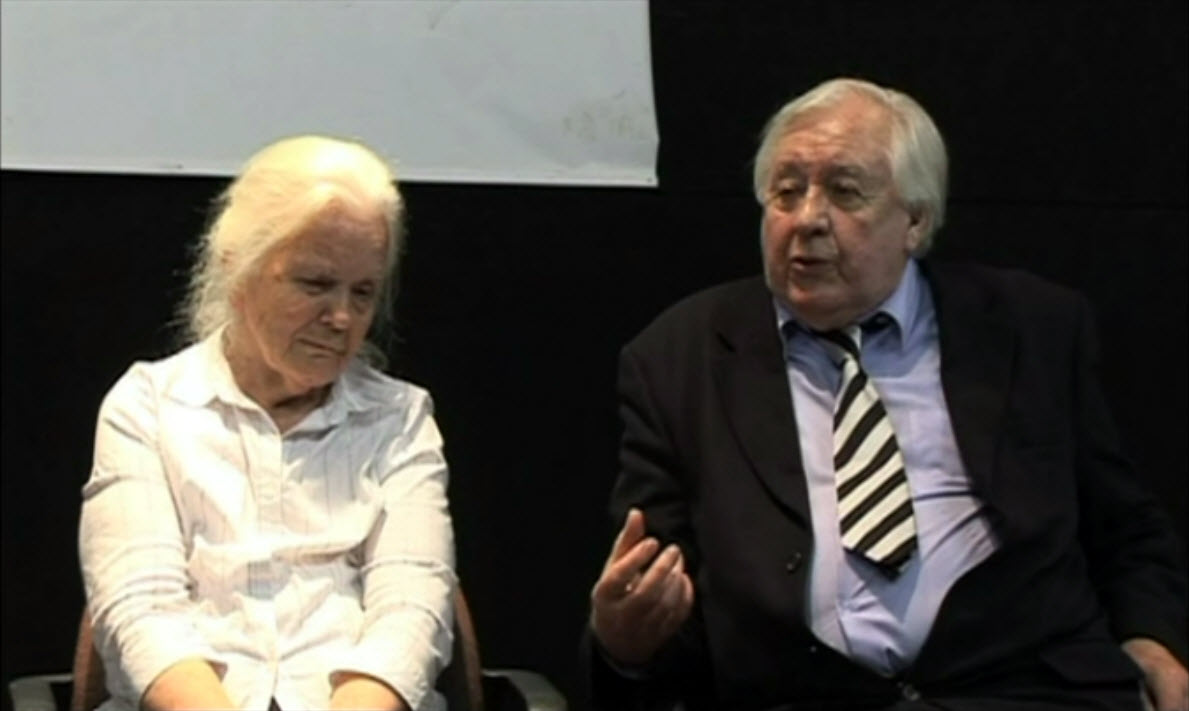
in the rigging of the Nigerian independence elections in 1956 and 1959, and suffered for it
And, remarkably, for 45 years (since 1960), one of the British colonial officials involved in the affair, Harold Smith, tried in vain to blow the whistle, but the British media which likes to think of itself as being free and fair (free to publish anything), will not touch the story even with a barge pole, apparently because it impinged on British national interests.
Yet, but for the British dirty work, the Northern domination of Nigerian politics which has caused so much angst in the country since independence, and is still causing more angst, and in fact led to Nigeria’s first coup d’etat in January 1966 and a subsequent civil war (1967-70) that killed over 2 million people, would not have arisen.
Britain: ‘We rig elections’
To fully understand this shocking story, here is a little preamble. On 13 April 2005, when I was the editor of the London-based New African magazine, I went with a colleague/photographer, Stuart Price, to a little place called Widbrook near Bradford on Avon in the southwest of England to interview a man called Harold Smith and his wife, Carol.
Mr Smith, then 79, was an Oxford graduate. He had joined the British Colonial Service in 1955 and was posted to Nigeria as a labour officer. At the time he was only 29.
Nigeria was being prepared for independence by Britain, which, ironically, did not want to lose its hold on the country because of the negative impact it would have on the British Empire. So while independence would come alright, Britain still wanted to exercise some control over independent Nigeria, using its “stooges in the North”.
As the then British defence secretary put it at a Cabinet meeting on 11 September 1958: “The strategic importance of Nigeria is sufficiently great to justify us making every effort to retain an enclave of territory under our own sovereignty.”
As such, the British decided to rig Nigeria’s independence elections in order to put their “friends” in the North in control. In fact, at the time many people did not know that rigging elections was a British speciality, and as they retreated from their colonies in Africa and elsewhere, rigging elections moved to another level.
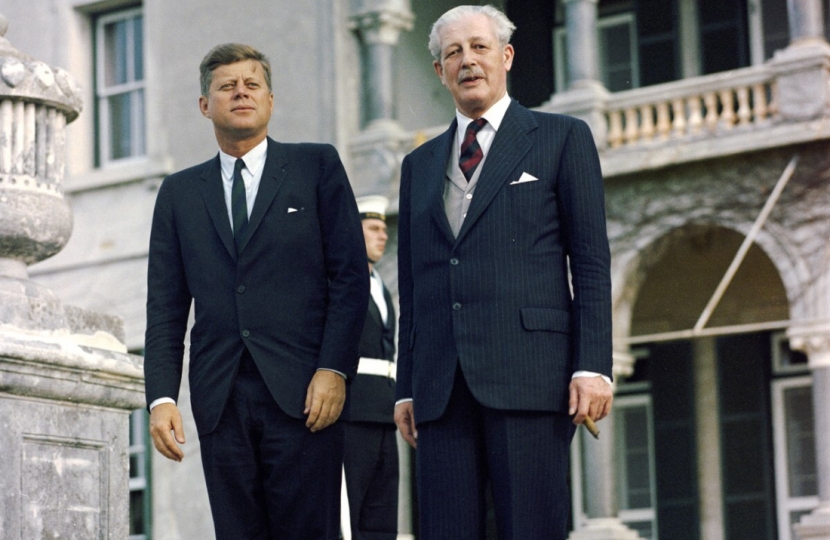
with the American President, J.F. Kennedy. Macmillan gave a speech in South Africa
about ‘the winds of change blowing in Africa”, and his prediction came true, blowing
Britain away from its African colonies
In September 2008, Harold Smith bought me a wonderful gift: Two volumes of four books published in 2000 and 2001, based, according to the editors, “overwhelmingly on hitherto unpublished material from the records of the Colonial Office, Foreign Office, Commonwealth Relations Office, and the Treasury, as well as from those of the Cabinet and its committees, and the Prime Minister’s Office”.
The volumes were titled “British Documents on the End of Empire” series. Together, the four books cost a tidy £500 to buy. Each book was 825 pages long, and Series A Volume 4, titled “The Conservative Government and the End of Empire 1957-64” (made up of two fat books) contains 583 official British documents on the end of empire.
The books were researched and edited by Dr Ronald Hyam and Roger Louis, who are said to be “two of the world’s pre-eminent historians of the British Empire”.
In one document, the minutes of a brainstorming meeting that took place in London on 14 December 1959, one British official called R.S. Hudson, made the following startling revelation: “Parliamentary democracy,” he said, “has failed in countries which are so varied that if there is a common cause, it is at least as likely to be found in the system as in the peoples.
“My own doubt is centred in the relationship between the Executive and Parliament. In the Westminster model, Parliament is the matrix of the Executive. When this model is exported to dependent territories, we [meaning the British] are forced in the transitional stages to modify it in the interests of strong and stable government. This we do by rigging the Parliament through official majorities, a restricted franchise, and so forth.”
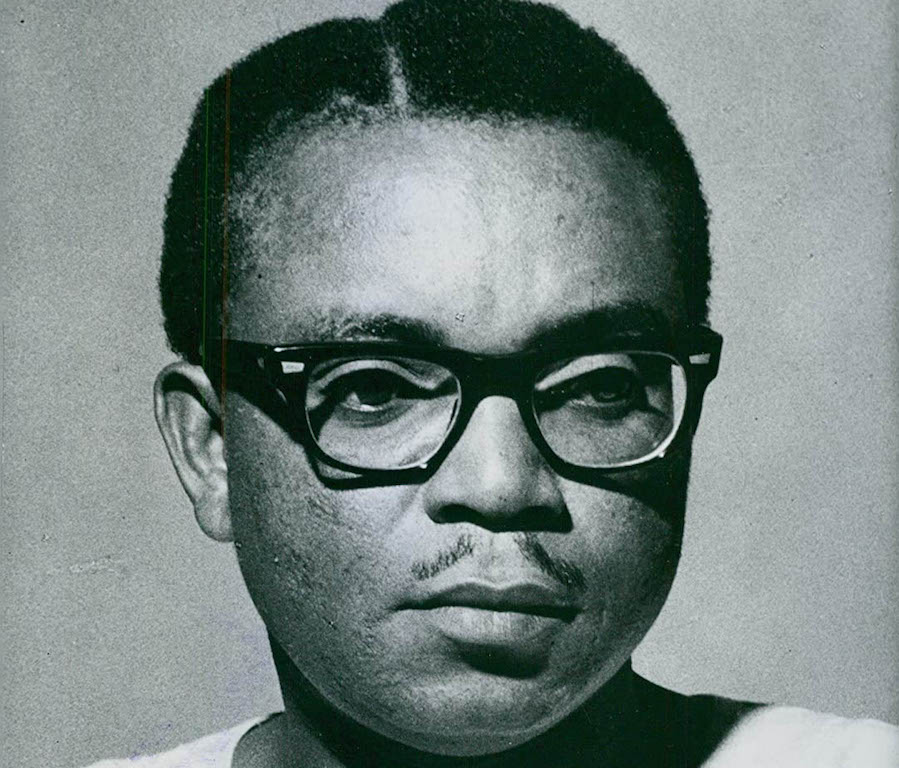
leading lights at the time, Chief
Anthony Enahoro, who was tipped
as one of the men to win the
independence elections, was jailed on
trumped-up treason charges to pave the
way for the Northern candidate Tafawa
Balewa. Enahoro got 15 years in jail
Hudson went on: “When the excitement of independence has died down, the successful government is brought face to face with the problems which faced us, for they are real problems such as the lack of education and the lack of nationhood. The new government cannot go back on universal suffrage but is as sure as we were that the Parliament must be rigged, if government is to be at all possible…
“I do not pretend to be able to see more than a few bits of the problem, but a very tentative deduction, which I should like to see examined by those who can see the problem whole, is that in the sort of country of which we are thinking [and they were thinking about Sudan], the Parliament must be rigged in some way or other.
“It might be a better and more lasting preparation for what always seems to follow if we, while we were able, adopted a different method of rigging and restricted the powers of Parliament rather than its composition.
“For example, Parliament must cease to be the matrix of the Executive, which could then be created separately and made much more independent of Parliament. Parliament might be made more a consultative body and less the source of the government of the country.
“If it is quite impossible to plan a different structure of government, and we must go on as we are, then possibly we should revise our ideas about party government.”
Hudson then went on to ask a very important rhetorical question and answered it himself: “Do we perhaps over-emphasise the role of opposition in our system?”, he asked. His answer: “In African territories, one party domination, so far from being a lapse into totalitarianism, may be the best way without disrupting the constitution, of ensuring stable government for the period while the country is developing true nationhood.”
What an answer! But Hudson was not finished. “One-party government,” he went on, “should perhaps be regarded with more sympathy as being the first natural substitute for the former benevolent colonial administration, an interim form of ‘indigenous’ democracy replacing our system of ‘applied’ democracy.”

were more than likely to win the independence elections, was also sent to jail on
trumped-up treason charges by the British to pave the way for its Northern “stooges”.
Awolowo got 10 years in jail
His conclusion was quite profound: “If the first alternative of changing the relationship between the Executive and Parliament proves impossible, I think that positive planning for one-party government might be more in accordance with the facts and might therefore help towards a more continuous and less jerky development.”
Hudson’s frank assessment was endorsed by the Assistant Under-Secretary of State at the Commonwealth Relations Office, one A.W. Snelling, who, on the same day, wrote to his boss, the Secretary of State, in these words:
“I urged Mr Walls to write up these notes on the Sudan constitutional developments because the lesson that the Westminster model of parliamentary democracy is not necessarily that best suited to African conditions is well brought out, and if ever we are to profit by it, the time is now … I have always felt that government on British lines was a non-starter in Africa.”
You can only shake your head, if you are an African, to hear this. These were British government officials thinking aloud in Whitehall that the British system of government does not benefit Africa in any way. “I have always felt that government on British lines was a non-starter in Africa,” A.W. Snelling wrote to the Secretary of State at the Commonwealth Relations Office. Yet since independence in Africa, that is the kind of government that we have practised, and still practising, in Africa – government on British, French or Portuguese lines. Any wonder that Africa still have problems with governance?
In fact, another British government official, M. E. Allen, reporting on the Colonial Secretary’s view on the preparations for Nigerian independence, admitted, in another official document, that: “The Colonial Secretary is certainly right in hesitating to assert that self-government will in Nigeria be good government … So far as the United Kingdom is concerned, it would appear that in the last resort, we must make sure that the government of Nigeria is strong, even if possibly undemocratic.”
And how were they going to achieve this – making sure that the government of Nigeria is strong, even if possibly undemocratic? Rig the independence elections!
Setting the scene
Now we need to go back in time to 1956. The sun was about to set on the mighty British Empire over which the sun was said to never set. Prime Minister Harold Macmillan’s landmark “winds of change” speech delivered in South Africa was having an effect. After much agonising, the British were retreating from West Africa almost in a panic.
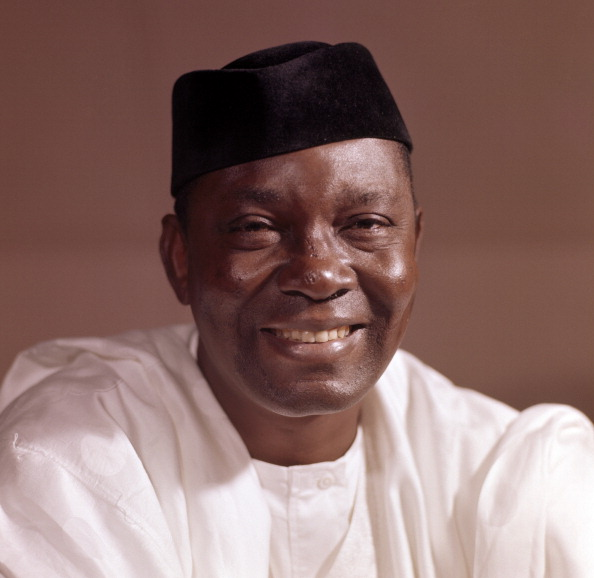
party in the East, was blackmailed by the British to work with them and the NPC in the
North against the Action Group in the West, because the British found that Azikiwe had
secretly misappropriated money deposited in his African Continental Bank
As Harold Smith, the star of this story, put it: “The withdrawal took place in haste, because world opinion was beginning to demand that the colonial powers spend money on their African possessions. If this suggests that Britain enhanced its colonies, it simply is not true. If this had been the case, then Britain would have left behind many more factories, plantations, roads, ports, and means of communication in Africa than she did … In 1947, Sir Hugh Foot found that there was not a single university in Nigeria or technical school, and in the North not one secondary school.”
But there was no turning back. Britain had to grant independence to its African colonies. In Nigeria, however, the same Britain, led by the same Harold Macmillan, would not leave until it made sure that in Harold Smith’s words, “its stooges in the North” would dominate the country after independence. It did not matter whether the Northerners were up to the task or not. As it happened, they were not! And Nigeria has suffered for it until today.
Perhaps the Africans were expecting too much from Britain. As Harold Smith put it: “When did Britain itself become a democracy, and has it yet achieved that state? With universal male suffrage in 1884 or when all women got the vote in 1928? Britain’s democratic traditions are of more recent origin than most are aware.
“When the British removed themselves from Nigeria in 1960 (though in truth they did not really surrender all power to the African people), there was not even universal suffrage as only a minority of the country’s women – those in the South – were entitled to vote.”
Nigeria’s independence elections were held in two stages, the first on a regional level in 1956, and the second on a federal level in 1959. The British did the counting of the votes in both instances and, according to their pre-set plan, they massaged the figures and the electoral process so that the politicians in the West, led by Chief Anthony Enahoro and Chief Obafemi Awolowo, who more than likely would have won the elections, were declared losers.
At the time, Nigeria’s three regions – North (dominated by the Hausa and Fulani), West (Yoruba) and East (Igbo) – had a measure of independence and were in effect federal states. The 1956 election was, thus, the final regional election before independence. So much was at stake that the major political parties mounted massive campaigns.
Smith said: “In many respects, it was difficult to detect in the North where the British administration ended and Northern rule
began. Thus, through a cynical display of horse dealing, the 1959 federal election became a mockery, because the outcome –
Northern domination of Nigeria after independence – was assured before a single vote was cast”
Enter Harold Smith
Then only 29, Harold Smith was a mere labour officer based in Lagos. In the absence of his boss, he had been chosen by the labour commissioner to “keep an eye on things”. In his autobiography written in 1987 (which no British publisher would touch it because of “the dynamite” it contains), Smith reveals:
“At this juncture, the order arrived which was to change my life. It had come through the chain of command, apparently from the Governor-General himself. It was addressed to me personally.
“The order directed me to arrange for all Nigerian staff of the [Labour] Department and all departmental vehicles to proceed to the Minister of Labour’s constituency for the duration of the election campaign to work under the Minister’s orders and to get his Igbo friends elected. This was a cover operation, and a cover story was needed. I was to devise a survey of migrant labour covering the Minister’s constituency.
“My reply was brief. ‘No’, I wrote on the minute sheet. ‘This would be a criminal act.’ … The British government was taking credit for its liberal policies in moving towards independence and the honest and fair handover of power to the new democratically-elected leaders of Nigeria. Yet here was chicanery and cynical interference in the electoral process beyond belief.”
The autobiography continues: “The British loved the North and had arranged for 50% of the votes to be controlled by the Northern People’s Congress (NPC), which was largely a creation of the British and hardly a normal party in the accepted sense. It was funded by the British-controlled Native Authorities and was quite simply a tool of the British administration.
“Because of this, independence was to some extent a sham because the results were a forgone conclusion. The North and the British would continue to rule. However, it was still possible that the two advanced and educated Southern parties would unite against the North, so it was necessary to keep them apart. Divide and rule, the old British device for creating conflict, was employed in its most brazen and cynical form to keep the Igbos and Yorubas from working together in Nigeria.”
According to Smith, it was British policy to encourage tribal rule in the East and West by discouraging the creation of new states which would have broken up the two power groups. “Of particular importance,” he said, “was the need for the NPC in the North to go unchallenged. And it was made quite clear to the leaders in the South that the British would not tolerate more than token electioneering against the NPC in the North.
“What was quite obvious from the orders coming out of Government House in 1956 was that Dr Nnamdi Azikiwe [leader of the largely Igbo NCNC party in the East] was working with the British and the NPC in the North against the Action Group in the West. [That was why Smith was ordered to go and help the NCNC via the Igbo Minister’s constituency in the East].
“In many respects,” Smith said, “it was difficult to detect in the North where the British administration ended and Northern rule began. Thus, through a cynical display of horse dealing, the 1959 federal election became a mockery, because the outcome – Northern domination of Nigeria after independence – was assured before a single vote was cast.
“The Northerners never really wanted the British to leave. They feared the Southerners more than the British. The British and the Northern elite worked so closely that differences of policy could hardly exist. The British claimed that the Northerners demanded – and must have – 50% of all the seats in a federal legislature. Was it really the Emirs who thought this up or did the British put them up to it?
“The British agreed anyway. Whoever controlled the NPC controlled the North and the whole of Nigeria. As the British and the Emirs were inseparable, elections were a mere formality.”
Harold Smith added: “This is the story of evil committed by kind, nice, decent British politicians. They sought to keep Britain from bankruptcy and found a solution in the mineral-rich Empire on the point of independence. It was necessary to bend the rules and sadly, in due course, the rules were totally forgotten. Those who got in the way were innocent but had to be dealt with quite harshly.”
And those “who got in the way” happened to be the opposition members of the Action Group in the West. A solution was found. They were sent off to jail on trumped up treason charges. Chief Enahoro got 15 years in jail, and Chief Awolowo 10 years. The seeds of destruction of Nigeria’s democracy had been sown, and the dark clouds of conflict and war were swirling on the horizon.
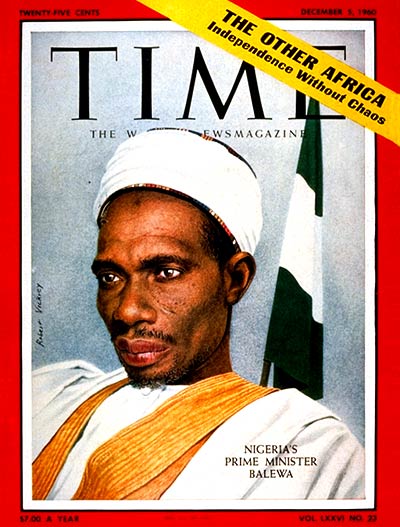
interest as usual, eulogised the British “stooge”, Prime Minister Tafawa Balewa, on
its 5 December 1960 front cover. Six years later, Balewa was killed in a coup d’etat
that overthrew his government on 15 January 1966. Harold Smith said: “The British
handed over power to a small and elite group of African leaders and civil servants
who were, for the most part, Britishers with black faces. And they continued to rule
as the British had ruled”
Harold Smith and the Governor-General
The Governor-General of Nigeria at the time was Sir James Wilson Robertson. He ahd told Harold Smith in the face in 1960 that the independence elections had been rigged by the British “because it was necessary”. He then threatened Smith to shut his “bloody mouth”. Or…
The Governor-General had met Prime Minister Macmillan when he was on his way to South Africa to make the “Winds of Change” speech. London had already agreed that “because of Britain’s self-interest”, Nigeria, one of the richest and most populous colonies in the British Empire, should be left in the safe hands of “friends of Britain” after independence. As such, the North had to win the independence elections by any means necessary.
For Governor-General Robertson and Macmillan’s government, everything went swimmingly in the 1956 and 1959 elections, except that there was one odd English young man in the Colonial Service in Lagos, the Labour Officer Harold Smith who would not do their bidding and keep quiet about it.
Smith, a dashing young man with a bright future at the time, had joined the Colonial Service in 1955 after obtaining a degree in Philosophy, Politics and Economics (PPE) at Oxford the previous year. He had met at Oxford the young lady who would become his wife and co-sufferer, Carol.
Born in Manchester in 1927, and at only 29 years of age, with movie-star good looks, his career was going well. He had brilliant reports. His name was soon known in the distant parts of Nigeria as “Smith the Lawmaker”, because he had drafted two of Nigeria’s laws – the Factories Act which was hailed at the time as the “finest piece of legislation to be placed on Nigeria’s statute book”, and the National Provident Act.
His seniors trusted him. They knew he always delivered on time. In short, he was a good man in the service of the Queen. But by 1956, he had become a thorn in the flesh of the British government in Nigeria because, as he put it, “I chose to believe in democracy and to consider it dishonourable and despicable to tamper with it.”
In fact, he was not alone. There were two other British officials in Lagos who, like Smith, had initially protested against the rigging of the 1956 elections. The two, however, later crumbled under pressure from the Governor-General and Whitehall. But Smith stood his ground.
As he told me in his home in the small village of Widbrook in 2005: “It was decided that I was the ringleader and should be punished. For 12 years, I suffered the devastating effects of poison which destroyed my gut and simulated the disease, Tropical Sprue, a disease found in Asia but rarely found in Africa.
“My chance of survival was remarkable and only after many years of medical research did I feel confident enough to re-commence my whistle-blowing. By this time, the British had created a wasteland in Nigeria.”
Smith continued: “Many people and institutions, including the oil companies and Tory and Labour politicians were all involved in interfering with the 1956 elections, when I, and my two colleagues, were ordered by Sir James to take a major role in the clandestine arrangement. It was evident on the ground that planning had been in hand for some time.
“And so, our stooges who did not want the British to leave had power thrust upon them. Nobody believed that the mass of people who followed the nationalist leaders in the South could possibly vote for the Northerners. In fact, few people voted for the Northerners, but who cared when the British were counting the votes!
“To leave friends in charge of Nigeria in our absence was surely prudent. The loss of one or two lives is all we can comprehend. An expedient Whitehall decision is clam and deliberate, and the risks, if ever considered, must be small and, of course, anonymous.”
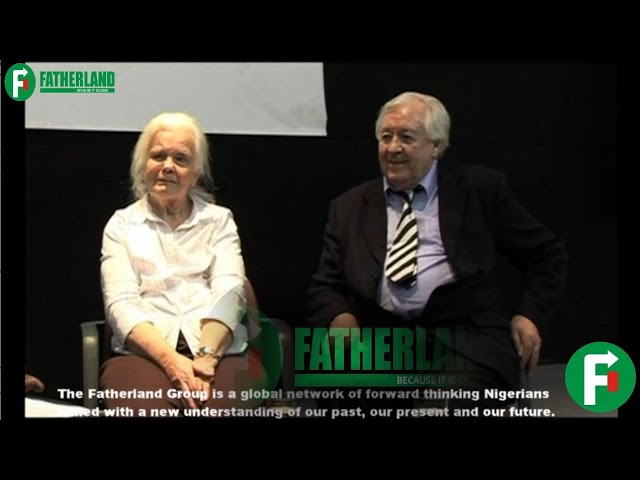
Fatherland, interviewed Carol and Harold on TV before they died. They told how
“the British sometimes selected crooks [into leadership in Nigeria] who they knew
they could control after independence … In fact, the Northerners never really
wanted the British to leave”
A dramatic meeting
It was clear at the time that Smith could not adequately fathom the enormity of the power he was fighting against when he confronted the Governor-General. Their meeting was quite dramatic.
“Sir James confessed to me,” Smith said, “that he had rigged the elections to let me know how much trouble I was in. ‘Why’, I pleaded. ‘Because it was necessary’, the Governor-General replied.
“Ah, necessity and Machiavelli, and oil,” Smith wrote in his 1987 autobiography. “Without oil, without the profits from oil, neither the UK nor Western Europe can survive. Of course, that was before we discovered oil in the North Sea.”
When Sir James called Smith to his grand office facing the Marina in Lagos, Smith says the Governor-General told him: “You know why you are here, Smith. And I want you to know that all your worst fears and suspicions are absolutely correct. All the accusations you have made are correct. I am telling you this because I want you to know how much trouble you are in.”
Smith the Lawmaker now knew he was in real trouble. “It is a cliché to say that my heart sank, but I use it deliberately because my heart was somewhere in my groin,” he tells in his autobiography. “I had wanted to be proved wrong, but I was being told from the highest possible source that my conclusions were correct. Britain had calmly, coldly, and with deliberation, set out to tamper with democracy in Nigeria.
“While I was absorbing this incredible disclosure, it became clear that in Sir James’ opinion, I was willfully disobeying orders on active service. I would now do exactly as I was told. And I had no choice.
“I listened to Sir James’ terms, and when he had finished, I said nothing. I looked at the portly figure of the most senior, the most powerful representative of the Queen in Nigeria, and very calmly pronounced two words: ‘No, Sir.’”
And Smith’s fate was sealed! A man of firm convictions, Smith may have perhaps allowed himself to be carried away by youthful exuberance, because most people would have taken Sir James’ word that there was a choice for Smith to redeem himself – keep his mouth shut and continue to be a golden boy, a high flier, an outstanding officer with appropriate remuneration and rewards. Or, as Sir James starkly put it. “You will never be employed by anybody again.”
Smith said: “I chose the latter course. I had no choice really. Cheating a fledgling nation out of its birthright was evidently routine practice for some. I could not see myself getting involved in this kind of intrigue. And of course, I thought I would somehow survive. In fact, I did survive, even though I found myself permanently retired at 33, with no salary or pension. I had only graduated at Oxford 6 years earlier.”
He continued: “The Governor-General simply could not understand why I should make such a fuss about which set of Africans the British chose to leave in charge in Lagos. If I would not play the game, I would have to take the consequences. I suppose this was the way Africans were treated, and it was decided I might profit from the same medicine.”
Smith told me that “Sir James had said forcefully: ‘You may be under a misapprehension, Smith. I want you to know that I personally gave the orders regarding the elections to which you objected. They were necessary.’
“But illegal, Sir,” Smith riposted.
“Sir James then tried a different tack: ‘Look here, Smith,’ he pleaded. ‘Be reasonable. Your work has been brilliant and outstanding. If you keep your mouth shut, I can promise rapid promotion and a most distinguished career elsewhere in government service overseas, but you will not be allowed to work in the UK. You must understand that you know too much for your own good. If you don’t give me your word, means will be found to shut you up. No one will believe your story and the press will not be allowed to print it.’”
The Governor-General was oozing power now. “You will never work in a responsible position in the UK again,” Smith said Sir James told him. “Be sensible and think of your own interest. You have had a taste of what lies in store for you.
“I was not personally responsible for what those Whitehall wallahs did to you back in the UK [when they forced the American oil company Esso to terminate Smith’s appointment as personnel manager after his first tour of duty in Nigeria ended]. Those Whitehall Johnnies are responsible for all this. Now be reasonable and we will forget the whole thing. Just give me your word and think of the brilliant career which lies ahead.’”
Smith said at that moment, he almost agreed with the Governor-General. But then Sir James shot himself in the foot by pressing too much and rounding furiously on Smith with threats. “You will never work in the UK again! You will be absolutely finished!”
Smith said he told Sir James: “It was very kind of you to see me, Sir. My position is unchanged. I cannot carry out unlawful orders. As I said ‘good bye Sir’, he turned away. He was very angry. Oddly enough, I felt sorry for him.”
Smith, the postman
True to the Governor-General’s word, Harold Smith never again worked in the UK till he died in 2011. At the time of the dramatic meeting with Sir James, Smith was only 33, in 1960. On his return to the UK, he tried two temporary jobs as a postman and labour clerk, and, as Sir James had predicted, the “Whitehall Johnnies” hounded him out. Imagine an Oxford graduate working as a postman! But they would not even allow him that.
Later, Whitehall realised that the stick alone would not keep Smith quiet, so they tried carrots. First, they gave him a secret trial in London, using the same top lawyers that Britain had used at the Nuremberg Trials against the Nazis, and found him not guilty of treason. Smith, out of work for so long and poor as a church mouse, was given no defence lawyer. He defended himself.
Then, they offered him a “pot of money”. He turned it down. They next tried a top job in the Far East plus permanent exile from England. He turned it down too. Finally, they offered him a knighthood. He refused that as well. Perhaps poison would make him change his mind. In fact, he nearly died.
Tropical Sprue (the strange disease Smith caught in Nigeria), attacks the gut and punches holes in it. For over 12 years, Smith battled with the disease, losing weight all the time, and becoming listless and helpless, until medical research came across an antidote in the late 1980s – don’t eat flour or anything powdery that will sink through the holes in the gut punched by the Sprue and into the bloodstream.
Having done two tours of duty in Nigeria (between 1955 and 1960), Smith still loved the country, even as late as 2005 when I interviewed him. He liked to talk about Nigeria as an authority. He felt exceedingly distressed that his beloved Britain “encouraged” Nigerian politicians in the pre-independence era to become corrupt.
He wrote in his 1987 autobiography: “A major proportion of the politicians who made Nigeria notorious for corruption after independence were selected by the British before independence. The politicians and leaders and men of eminence not chosen were often honest, trustworthy, and responsible people. Why were these people not brought in by the British? The answer is that the British needed people they could control. They sometimes selected crooks whom they knew they could control after independence.”
Smith insisted that Nigerian institutions “did not become corrupt after independence, they were crooked before the British handed over power to a small and elite group of African leaders and civil servants who were, for the most part, Britishers with black faces. And they continued to rule as the British had ruled.”
The British media
In 1987, after 27 years of trying in vain to get the British media interested in his story (even The Guardian, considered to be the most liberal and progressive of all British newspapers, would not publish it), Smith wrote his autobiography based mainly on his Nigerian experience.
When I interviewed him on 13 April 2005 for New African magazine, Smith’s book had not been published in hard copy by any British or Western publisher because of its contents. After not getting any joy from the long list of publishers he contacted, Smith finally set up his own website (www.libertas.demon.co.uk) and published the book on the site for free.
He and his supportive wife, Carol, showed me piles of letters going back 45 years that they had exchanged with British editors, politicians, prime ministers, and other officials – all in an attempt to get their story into the public domain. Except for one or two small provincial newspapers, none of the British mainstream media (both press and electronic) had shown any interest in his story.
For The Guardian alone, between 1989 and 2003, Smith and Carol (a former headmistress and later inspector of schools) wrote 19 letters to the then editor, Peter Preston, urging him to publish their story. They got no reply.
They similarly wrote 24 letters between 1995 and 2005 to Preston’s successor, Alan Rushbridger, and The Guardian editor did not reply once.
However, from 1988 to 1994, correspondence developed between the Smiths and The Guardian’s former chief columnist and chairman of the Scott Family Trust that publishes the paper, Hugo Young, a fire and brimstone kind of journalist. But no joy came out of the exchange.
In the end, Hugo Young told Harold Smith, in writing on 13 May 1994: “I have not the least idea what The Guardian did or did not do about Nigeria long before I joined it. You seem to be in a state of demented obsession … This will be my last communication. Do not trouble our fax machine or our secretaries anymore.”
A year before this letter, Hugo Young had written to Harold Smith on 2 June 1993, saying: “Reading through the written material, however, it occurs to me that perhaps there is a simpler reason of why your story has not been published. Maybe in an earlier period, pre-1990 when the 30-year rule [during which official documents are classified] would have bitten, you had some cause to feel that the authorities were trying to suppress something and the newspapers were their allies – but I stress I have absolutely no knowledge of any involvement on The Guardian’s part.
“Now, however, it is at least possible that the problem is journalistic. Is the Nigerian election of 1960, however corrupt, a story our readers will be interested in? I think one can make a cool judgement on that without being charged with begging for a knighthood.”
Amazing, isn’t it? Today, in 2023, a good 30 years after the venerable Hugo Young penned those memorable words, the British media is still publishing stories about Adolf Hitler and World War II, and some small bridge that Hitler and his Nazis couldn’t take in Poland. And their readers and viewers and listeners are damn interested in those stories. But World War II ended in 1945. Nigerian independence was in 1960. And Hugo Young was insinuating in 1993 that readers of The Guardian would not be interested in the Nigerian election of 1960, however corrupt?
The short of it all is that Sir James Robertson, the Governor-General, an establishment figure, had told Harold Smith that if he did not keep quiet, means would be found to shut him up, and the media would not be allowed to run his story, in the interest of British national interest. And that exactly was what happened! So, despite knocking at the doors of every media house, every year, for 45 years since 1960, Smith could not interest the British media to run his Nigerian story.
During those 45 years, Smith and his wife Carol also wrote 3 times between 1993 and 1994 to The Guardian’s deputy editor, Jonathan Fenby, and got no reply. The couple took the fight to other journalists and writers at The Guardian and the BBC, and though some did reply, they would not publish his story.
But desperate to get the story out, Smith wrote to the “Letters Column” of The Independent (another middle-of-the road British newspaper based in London), and though his letter was published, the paper would not follow up and do a bigger piece on the rigging of the Nigerian independence elections.
The Smiths tried all the other British mainstream media – from the BBC to The Times, The Observer, The Daily Telegraph and all – and none of them would publish how Britain rigged Nigeria’s independence elections and stitched up the country.
In mid-March 2005, he finally came to us at New African, a good 45 years after he had tried and tried and tried to get the British media interested in his story. When I finally interviewed him in his home on 13 April 2005, I became the first mainstream journalist in the world to go to Widbrook and get Smith’s story and run it as the front cover story for the New African May 2005 issue – 18 years ago! Incidentally, I wrote the story in my room at the Rainbow Towers Hotel in Harare, where I had come on one of my famous reporting trips to Zimbabwe.
After my report in New African, other journalists (African and otherwise, in both print and TV) went to interview Harold Smith and Carol, and amplified their Nigerian story. When Smith died in 2011, I represented Africa at his funeral. Carol, totally heartbroken after her husband’s death, managed to hang on for 10 more years without Harold. She died on 8 January 2023.
In a moving obituary for Carol, the London-based Nigerian media group, Fatherland, which did a TV interview with both Harold and Carol before they died, said about Carol: “She was the second half of the formidably courageous and principled couple who dared to speak truth to power, to Nigeria’s Governor General in the run up to the country’s independence elections, Sir James Robertson, to the British government and to the world, over the rigging of Nigeria’s independence elections.
“They sacrificed what would have been a comfortable life to speak about the British colonial government’s foul play with democracy which led to Nigeria’s sorry record of military coups, the Biafran War, corruption, and the general state of retarded development and insecurity which plague the country today.
“The debt that Nigerians owe to Carol and Harold Smith for the insights which they shared is too great to ever be fully repaid. However, Nigerians now know that any history of Nigeria which does not mention their account is no true history of Nigeria.”
May they rest in eternal peace. Africa owes them a million.
Leave a Reply