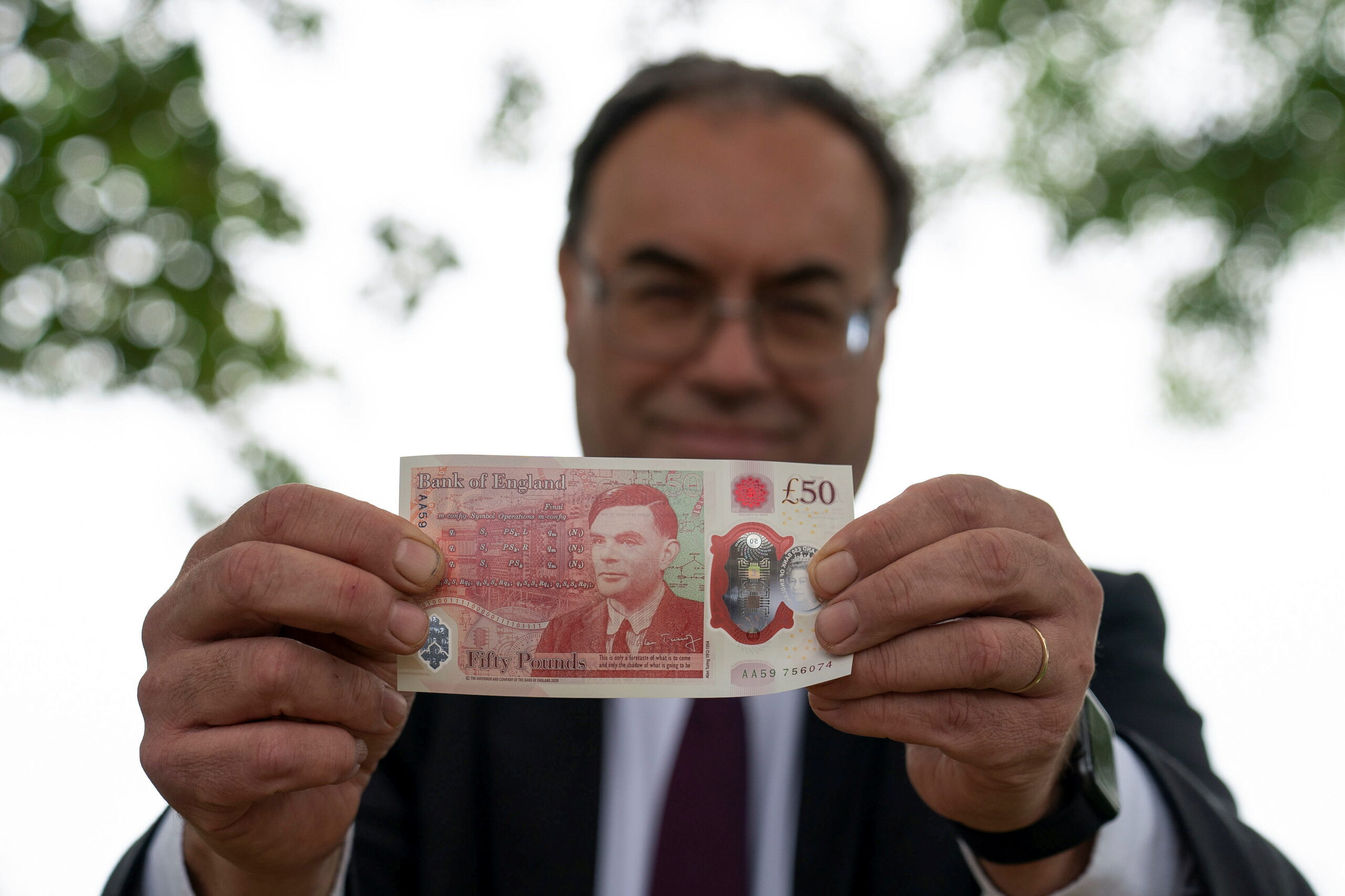
“This is only a foretaste of what is to come and only the shadow of what is going to be” – Alan Turing, the British mathematician and codebreaker, speaking in an interview with The Times (of London) on 11 June 1949.
Alan Turing makes me to worry. He takes me back to my column of our last issue – why Africa should stand firm against homosexuality. “This is only a foretaste of what is to come and only the shadow of what is going to be”. Frightening! Simply frightening!
For those who have not seen Britain’s new £50 note (in polymer, not paper), which came into circulation on the birthday of Alan Turing (23 June 2021), please see the photo on the opposite page. It is the reverse side of the £50 note, the highest denomination in the UK. Some time ago, there were fears that the note was widely used by criminals and rarely for ordinary purchases. The fear provoked a government-led discussion on whether to abolish the note. Peter Sands, the former CEO of the Standard Chartered Bank, actually believes the note is the “currency of corrupt elites, of crime of all sorts, and of tax evasion”.
But in its infinite wisdom, the Bank of England (which is to say the British government) decided to stick with the £50 note and even redesign it, and print it in plastic like all the other notes in circulation (the £5, £10, and £20 notes were already in polymer, instead of paper). The idea was to make the notes more secure, durable, and harder to forge.
So the reverse side of the new £50 note features a photo of Alan Turing taken in 1951 by Elliott and Fry, and a table and mathematical formulae from Turing’s 1936 paper, “On Computable Numbers, with an application to the Entscheidungsproblem” – which is said to be foundational for computer science.
There is also a photo of an Automatic Computing Engine (ACE) Pilot Machine – “the trial model of Turing’s design and one of the first electronic stored-programme digital computers”, we are told. There is also the “technical drawings for the British Bombe, the machine specified by Turing and one of the primary tools used to break German Enigma-enciphered messages during World War II”.
To run off the design, there is also Turing’s quote from the 11 June 1949 interview with The Times: “This is only a foretaste of what is to come, and only the shadow of what is going to be.”
Finally, there is Turing’s signature from the visitor’s book at Bletchley Park in 1947. Bletchley Park in Buckinghamshire was the location of the British code-breaking efforts, which Turing is said to have played a huge part of, and his and his colleagues efforts helping so much to cut short World War II by “two to four years”.
To situate Turing and his colleagues’ efforts, let me say that before and during World War II, the “Enigma” was a device used by the dreaded German military command to encode strategic messages to confuse the enemy. But the Enigma code was first broken in the early 1930s by the Poles, under the leadership of their mathematician, Marian Rejewski.
However, in 1939, with the growing likelihood of a German invasion of Poland, the fearful Poles turned their information over to the British, who set up a secret code-breaking group known as Ultra at Bletchley Park, where a certain mathematician called Alan Mathison Turing worked. It is said that because the Germans shared their encryption device with the Japanese, Ultra also contributed to Allied victories in the Pacific.
A genius forsaken?
So who is Alan Turing? He was born in Maida Vale, West London, on 23 June 1912, as the second of the two sons of a civil servant, Julius Mathison Turing and his wife Ethel Sara Stoney, who had met in imperial India, where Turing the father was a senior colonial administrator. After Alan’s birth, his parents left him and his brother, John, in the care of foster parents in England while they returned to India for the father to continue his work.
Depending on who you listen to, the adjectives describing Turing become more superlative. Wikipedia describes him as: “An English mathematician, computer scientist, logician, cryptanalyst, philosopher, and theoretical biologist … Turing was highly influential in the development of theoretical computer science, providing a formalisation of the concepts of algorithm and computation with the Turing machine, which can be considered a model of a general-purpose computer. He is widely considered to be the father of theoretical computer science and artificial intelligence.”
Encyclopedia Britannica says: “Alan Turing was a British mathematician and logician who made major contributions to mathematics, cryptanalysis, logic, philosophy, and mathematical biology and also to the new areas later named computer science, cognitive science, artificial intelligence, and artificial life.”
Biography.com adds that: “Turing was a brilliant British mathematician who took a leading role in breaking Nazi ciphers during World War II. In his seminal 1936 paper, he proved that there cannot exist any universal algorithmic method of determining truth in mathematics, and that mathematics will always contain undecidable propositions. His work is widely acknowledged as foundational research of computer science and artificial intelligence.”
The Sun newspaper (of London) says: “Turing, a British hero, is often considered the father of computer science who played a pivotal role in breaking the Enigma code. He had a lasting impact on the way we live today, and his legacy continues as the face of the new £50 note … Turing was part of a research team working at Bletchley Park in Buckinghamshire. He is credited with shortening World War II by two to four years, and was awarded an OBE in 1945.”
Mark Carney, a Canadian economist and banker who served as the governor of the Bank of Canada from 2008 to 2013 and the governor of the Bank of England from 2013 to 2020, says: “Alan Turing was an outstanding mathematician whose work has had an enormous impact on how we live today. As the father of computer science and artificial intelligence, as well as a war hero, Turing’s contributions were far-ranging and path breaking. Turing is a giant on whose shoulders so many now stand.”
Time magazine joined the adulation naming Turing in 1999 as one of the “100 Most Important People of the 20th Century” and stated: “The fact remains that everyone who taps at a keyboard, opening a spreadsheet or a word-processing programme, is working on an incarnation of a Turing machine.”
Turing’s co-worker, Peter Hilton recounted his experience working with him in Hut 8 in his book, Reminiscences of Bletchley Park: “It is a rare experience to meet an authentic genius. Those of us privileged to inhabit the world of scholarship are familiar with the intellectual stimulation furnished by talented colleagues. We can admire the ideas they share with us and are usually able to understand their source; we may even often believe that we ourselves could have created such concepts and originated such thoughts.
“However, the experience of sharing the intellectual life of a genius is entirely different; one realises that one is in the presence of an intelligence, a sensibility of such profundity and originality that one is filled with wonder and excitement. Alan Turing was such a genius, and those, like myself, who had the astonishing and unexpected opportunity, created by the strange exigencies of the Second World War, to be able to count Turing as colleague and friend will never forget that experience, nor can we ever lose its immense benefit to us,” Hilton wrote of his colleague, Turing.
Another of Turing’s colleagues, Hugh Alexander, the actual head of Hut 8 at Bletchley Park, wrote of Turing’s contribution: “There should be no question in anyone’s mind that Turing’s work was the biggest factor in Hut 8’s success. In the early days, he was the only cryptographer who thought the problem worth tackling and not only was he primarily responsible for the main theoretical work within the Hut, but he also shared with Welchman and Keen the chief credit for the invention of the bombe.
“It is always difficult to say that anyone is ‘absolutely indispensable’, but if anyone was indispensable to Hut 8, it was Turing. The pioneer’s work always tends to be forgotten when experience and routine later make everything seem easy, and many of us in Hut 8 felt that the magnitude of Turing’s contribution was never fully realised by the outside world.”
And the man spent only 41 years on earth and returned to his ancestors in his prime!
A giant rejected?
So, if Turing was the “giant” that they and his work describe him to be, why is he almost unknown to the world? Let me use their own words to tell why.
Alan Cowell, writing in The New York Times on 5 June 2019, reveals that: “… By the narrow standards of his day, his reputation was sullied. On June 7, 1954, Turing, a British mathematician who has since been acknowledged as one of the most innovative and powerful thinkers of the 20th century – sometimes called the progenitor of modern computing – died as a criminal, having been convicted under Victorian laws as a homosexual and forced to endure chemical castration. Britain didn’t take its first steps toward decriminalising homosexuality until 1967.”
Before we go further, please mark the year, 1967. Cowell notes that “Britain didn’t take its first steps toward decriminalising homosexuality until 1967”. And Britain is said to have become a nation since the Norman victory at the Battle of Hastings on 14 October 1066. If you subtract 1066 from 1967, you get 901 years. That is the time Britain gave itself to deal with, and accept, homosexuality as a new “human right”.
Now let’s move on. According to the official records, Turing started a homosexual relationship with Arnold Murray, 19, after meeting him just before Christmas in Manchester. After his house was burgled and a police report filed, Turing acknowledged his sexual relationship with Murray. Both men were charged with “gross indecency”. So to the British and much of their cousins in Europe, homosexuality was “gross indecency”. It was not just “indecency”, but “gross” on top of it.
Interestingly, 11 years before his conviction as a homosexual, Turing had proposed marriage to a female colleague, Joan Clarke, a fellow mathematician and cryptanalyst, who worked with him in Bletchley Park’s Hut 8. But their engagement was short-lived. “After admitting his homosexuality to his fiancée, who was reportedly ‘unfazed’ by the revelation, Turing decided that he could not go through with the marriage,” one writer reports.
Another British writer tells the Turing story in a more expanded form: “In January 1952, Turing was 39 when he started a relationship with Arnold Murray, a 19-year-old unemployed man. Just before Christmas, Turing was walking along Manchester’s Oxford Road when he met Murray just outside the Regal Cinema and invited him to lunch.
“On 23 January, Turing’s house was burgled. Murray told Turing that he and the burglar were acquainted, and Turing reported the crime to the police. During the investigation, he acknowledged a sexual relationship with Murray. Homosexual acts were criminal offences in the United Kingdom at that time, and both men were charged with ‘gross indecency’ under Section 11 of the Criminal Law Amendment Act 1885. Initial committal proceedings for the trial were held on 27 February [1952] during which Turing’s solicitor ‘reserved his defence’, i.e, did not argue or provide evidence against the allegations.
“Turing was later convinced by the advice of his brother and his own solicitor, and he entered a plea of guilty. The case, Regina v. Turing and Murray, was brought to trial on 31 March 1952. Turing was convicted and given a choice between imprisonment and probation. His probation would be conditional on his agreement to undergo hormonal physical changes designed to reduce libido, known as ‘chemical castration’.
“He accepted the option of injections of what was then called stilboestrol (now known as diethylstilbestrol or DES), a synthetic oestrogen; this feminisation of his body was continued for the course of one year. The treatment rendered Turing impotent and caused breast tissue to form, fulfilling in the literal sense Turing’s prediction that ‘no doubt I shall emerge from it all a different man, but quite who, I’ve not found out’. Murray was given a conditional discharge.
“Turing’s conviction led to the removal of his security clearance and barred him from continuing with his cryptographic consultancy for the Government Communications Headquarters (GCHQ), the British signals intelligence agency that had evolved from GC&CS in 1946, though he kept his academic job. He was denied entry into the United States after his conviction in 1952, but was free to visit other European countries.”
The Americans would not allow Turing, such a great Briton, to enter their country because he was a homosexual. Please mark that fact.
Dead at 41
I shall continue to use their own words to tell the story. Another British writer says: “On 8 June 1954, at his house at 43 Adlington Road, Wilmslow, Turing’s housekeeper found him dead. He had died the previous day at the age of 41. Cyanide poisoning was established as the cause of death. When his body was discovered, an apple lay half-eaten beside his bed, and although the apple was not tested for cyanide, it was speculated that this was the means by which Turing had consumed a fatal dose. An inquest determined that he had committed suicide.
“Turing had reportedly borne his legal setbacks and hormone treatment (which had been discontinued a year previously) ‘with good humour’ and had shown no sign of despondency before his death.”
This is confirmed by the Encyclopedia Britannica: “In the midst of this groundbreaking work,” the Britannica says, “Turing was discovered dead in his bed, poisoned by cyanide. The official verdict was suicide, but no motive was established at the 1954 inquest. His death is often attributed to the hormone ‘treatment’ he received at the hands of the authorities following his trial for being gay. Yet he died more than a year after the hormone doses had ended, and, in any case, the resilient Turing had borne that cruel treatment with what his close friend Peter Hilton called ‘amused fortitude.’”
The Britannica was not finished: “Although suicide cannot be ruled out,” the Britannica says, “it is also possible that his death was simply an accident, the result of his inhaling cyanide fumes from an experiment in the tiny laboratory adjoining his bedroom. Nor can murder by the secret services be entirely ruled out, given that Turing knew so much about cryptanalysis at a time when homosexuals were regarded as threats to national security.”
Did you hear that? At a certain point in time, the British and their cousins in Europe and in the wider Western world regarded homosexuals as “threats to national security”!! And the same people are telling Africans and the world today to accept homosexuality, and practise it, whether we like it or not.
Posthumous pardon(s)
So let’s stay with Turing. He was officially pardoned in 2013 – and thousands of other homosexuals followed suit after Queen Elizabeth II signed the Police and Crime Act into law. The pardon started as a petition campaign in August 2009, by the British programmer John Graham-Cumming who urged the government to apologise for Turing’s prosecution as a homosexual.
Cumming’s petition received more than 30,000 signatures, forcing the then prime minister, Gordon Brown, to acknowledge the petition in a statement on 10 September 2009, in which he apologised and described the treatment of Turing as “appalling”.
Said Brown: “Thousands of people have come together to demand justice for Alan Turing and recognition of the appalling way he was treated. While Turing was dealt with under the law of the time and we can’t put the clock back, his treatment was of course utterly unfair and I am pleased to have the chance to say how deeply sorry I and we all are for what happened to him …
“This recognition of Alan’s status as one of Britain’s most famous victims of homophobia is another step towards equality [which is] long overdue. But even more than that, Alan deserves recognition for his contribution to humankind …
“It is thanks to men and women who were totally committed to fighting fascism, people like Alan Turing, that the horrors of the Holocaust and of total war are part of Europe’s history and not Europe’s present. So on behalf of the British government, and all those who live freely thanks to Alan’s work, I am very proud to say we are sorry, you deserved so much better.”
Two years after Gordon Brown’s apology (in December 2011 to be precise), the Manchester MP John Leech, and his constituent William Jones, started an e-petition asking the British government to pardon Turing for his conviction of “gross indecency”.
They told the government: “In 1952, [Turing] was convicted of ‘gross indecency’ with another man and was forced to undergo so-called ‘organo-therapy’ – chemical castration. Two years later, he killed himself with cyanide, aged just 41. Alan Turing was driven to a terrible despair and early death by the nation he had done so much to save. This remains a shame on the British government and British history. A pardon can go some way to healing this damage. It may act as an apology to many of the other gay men, not as well-known as Alan Turing, who were subjected to these laws.”
Again, this petition gathered over 37,000 signatures, but on submission to Parliament, Justice Minister Lord McNally, kicked against it, arguing that: “A posthumous pardon is not considered appropriate as Alan Turing was properly convicted of what at the time was a criminal offence. He would have known that his offence was against the law and that he would be prosecuted. It is tragic that Alan Turing was convicted of an offence that now seems both cruel and absurd – particularly poignant given his outstanding contribution to the war effort. However, the law at the time required a prosecution and, as such, longstanding policy has been to accept that such convictions took place and, rather than trying to alter the historical context and to put right what cannot be put right, ensure instead that we never again return to those times.”
It was a setback for Turing’s supporters. But between 2005 and 2015, Leech continued the campaign in Parliament, submitting bill after bill for Turing’s pardon, arguing that his contribution to World War II made him a “national hero” and that it was “ultimately just embarrassing” that the conviction still stood. Eventually, Leech gained public support of numerous leading scientists, including Stephen Hawking.
On 26 July 2012, a bill was introduced in the House of Lords to grant a statutory pardon to Turing. Gordon Brown’s government supported the bill, but at its second reading in the House of Commons on 29 November 2013, Tory MP Christopher Chope objected to the bill and delayed its passage.
But the government circumvented the block in Parliament by electing to proceed under the royal prerogative of mercy. So on 24 December 2013, Queen Elizabeth II signed a pardon for Turing’s conviction for “gross indecency”, with immediate effect. The Lord Chancellor Chris Grayling announced the pardon and said Turing deserved to be “remembered and recognised for his fantastic contribution to the war effort” and not for his later criminal conviction.
The Queen officially pronounced Turing pardoned in August 2014. As one British writer noted: “The Queen’s action is only the fourth royal pardon granted since the conclusion of the Second World War. Pardons are normally granted only when the person is technically innocent, and a request has been made by the family or other interested party; neither condition was met in regard to Turing’s conviction.
“In September 2016, the government announced its intention to expand this retroactive exoneration to other men convicted of similar historical indecency offences, in what was described as an ‘Alan Turing law’, [which] is now an informal term for the law in the United Kingdom, contained in the Policing and Crime Act 2017, which serves as an amnesty law to retroactively pardon men who were cautioned or convicted under historical legislation that outlawed homosexual acts. The law applies in England and Wales.”
In effect, as many as 75,000 gay and bisexual men and women were convicted under the Sexual Offences Act when homosexuality was a crime in Britain. Those who were still alive were asked to fill out a form to have the conviction removed from their criminal records. In the end, pardons were automatically granted to 59,000 men who had died, including Oscar Wilde who was convicted under the Act in 1895 for having sex with over 12 young men between 1892 and 1894. He was sentenced to two years’ hard labour.
So as many as 75,000 men were convicted and jailed by Britain for being homosexuals. And 59,000 of them got automatic posthumous pardons in 2017. Please mark that fact.
What does Turing’s story say?
The main point is that although Turing, an absolute genius who spent only 41 years on earth, and was appointed an officer of the Order of the British Empire (OBE) in 1945, and also elected a Fellow of the Royal Society (FRS) in 1951, was not saved by his high accomplishments and patriotic service to the nation; those things mattered not a jolt when he was caught as a homosexual.
And now comes the rub. I have told the Turing story very slowly, using the British people’s own words, so that its import will not be missed by anybody. Turing’s story tells us that for 901 years, and even more, Britain and its Western allies considered homosexuality so vile against their national morality and sensibilities that no matter the offender’s station in life, the State would not bend the law and national morality to give a pass to any homosexual. It was as much abhorred then as paedophilia (having sex with children) is hated today.
In effect, the British and their cousins in the wider West have given themselves enough time to come to terms with homosexuality. They gave themselves as many as 1,000 years or more, dear reader, before homosexuality became, to them, a new “human right”. What becomes nauseating is that because, to them, homosexuality is now a “human right”, it must also be a “human right” for the African and the rest of the world. We, in Africa and elsewhere, don’t have to have 1,000 years to come to terms with it. We must just accept it at the say-so of the West. That gets my goat, ladies and gentlemen.
And not only that: Another thing gets my goat in this matter, and it is that one fine day, in the near future, when the same West had come to terms with having sex with children and had moved paedophilia into the realm of a “new human right”, they will turn to Africa and the rest of the world and try to force it down our throats, saying we too must accept paedophilia as a “new human right”. In those days they would come up with a new sin called “paedophobia”, like “homophobia”, and it would be such a great sin to commit.
Remember Turing’s quote immortalised by the Bank of England on the £50 note: “This is only a foretaste of what is to come and only the shadow of what is going to be”. We can see it already. Why was he chosen for the £50 note? It is said the pivotal role he played in the development of early computers, first at the National Physical Laboratory and later at the University of Manchester, besides his codebreaking accomplishments, is less celebrated, and the Bank of England felt his legacy continues to have an impact on science and society today.
According to reports, “The Bank asked the public to offer suggestions for the scientist whose portrait should appear on the £50 note. In six weeks, the Bank received 227,299 nominations covering 989 eligible scientists. A shortlist was drawn up by a committee, including experts from the field of science, before the governor [of the Bank] made the final decision.”
So “the public” voted him in, to complete his rehabilitation that started with the petition campaigns of the Apology and Pardon, and now we have his photo in everyone’s face on every blessed day via the £50 note. Truly, “this is only a foretaste of what is to come and only the shadow of what is going to be” indeed.
The creep, creep, creep approach about homosexuality has already broken into a sprint. At the just concluded FIFA World Cup in Qatar, the European teams wanted their captains to wear armbands eulogising homosexuality. Thank God, FIFA did not give in. Some people must stand up and say No! No, it affronts our national morality and sensibilities! No, we abhor it! So give us 1,000 years or more to think about it as you gave yourselves.
Leave a Reply