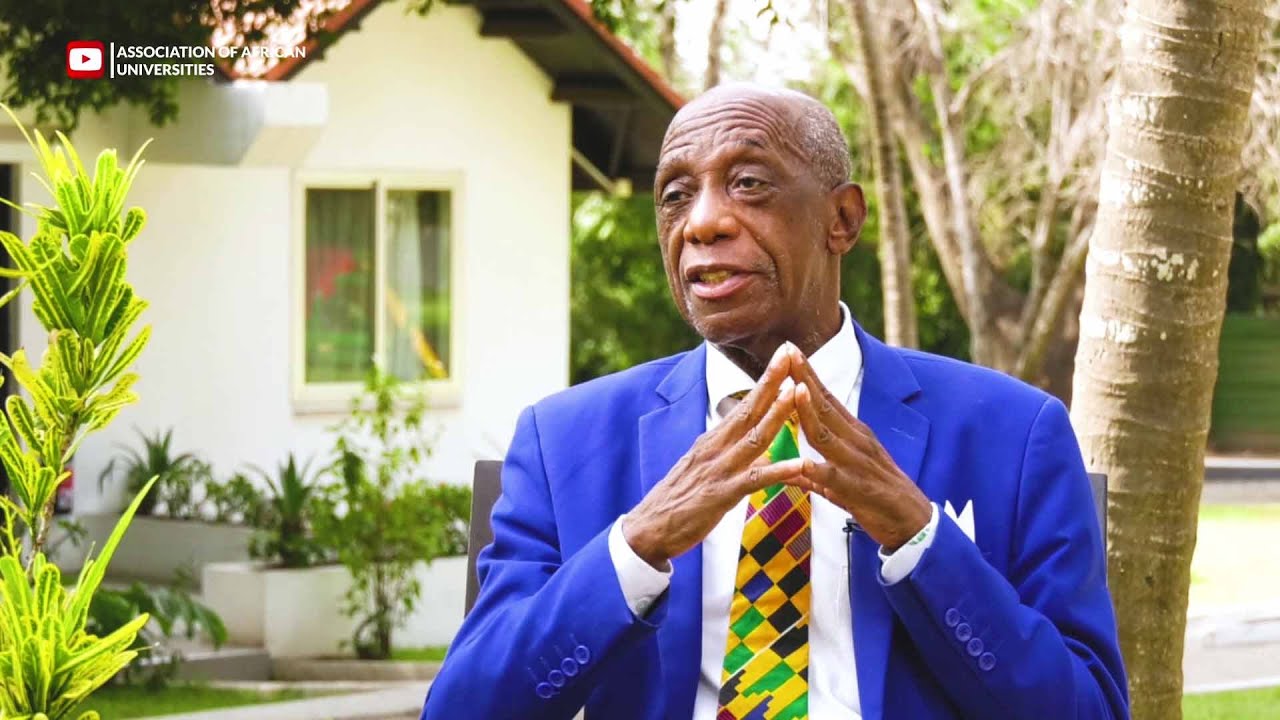
October is Black History Month in Britain, and February is Black History Month in the USA, two months during which the great and good of Global Africa are celebrated. Two names that have come up this year deserve their place on the list of celebrants by sheer merit: Dr Thomas O. Mensah, 72, a Ghanaian-American chemical engineer and inventor who contributed immensely to the development of laser-guided missiles for the US military, and Jesse E. Russell, 73, an African-American inventor whose innovations in digital signal processing led to the modern mobile phone that changed the world.
Dr Mensah is an expert in fibre optics and nano technology. But for him the field of fibre optics would not be what it is today. The same can be said of Jesse Russell in the field of digital communications technology – but for him also mobile phones and digital communications as a whole would not be what we know them today.
The massive contributions of these sons of Global Africa have greatly changed the world, but you will not find their names in neon lights like some of their white colleagues who are celebrated worldwide. In fact, most Africans and people of African descent worldwide have not even heard about them. But they are the very two persons whose work has made it possible for the world to enjoy the current high level of digital communication, and even helped the US military to assert its supremacy in the field of laser-guided missiles.
Known as one of the great minds of the 21st century, Dr Mensah was born in Kumasi, Ghana. His father, J. K. Mensah, was a cocoa merchant who shipped cocoa beans to France. No wonder, France would play a huge role later in the academic development of his son.
Young Mensah attended Adisadel College at Cape Coast, Ghana, and obtained his first degree in chemical engineering at the Kwame Nkrumah University of Science and Technology in Kumasi. Life then changed for the better for him after he received a French government scholarship to study at the Montpellier University in France.
While at Montpellier, he participated in a programme at the Massachusetts Institute of Technology (MIT) in Cambridge, Massachusetts, in 1977, and received a certificate in modeling and simulation of chemical processes from the MIT. A year later, he obtained his PhD in chemical engineering from Montpellier University, and life has never been the same again.
Mensah emigrated to the US after his PhD studies, and worked at Air Products and Chemicals in Allentown, Pennsylvania, before moving on to Corning Glass Works in New York where he worked on fibre optic research at Sullivan Park.
According to one writer: “Researchers at Corning had previously developed fibre optic with loss below the crucial attenuation limit of 20 decibels per kilometre, but the fibres could not be manufactured at rates higher than 2 meters per second. Mensah improved the manufacturing process through a series of innovations, raising the speed of manufacture to 20 meters per second by 1985.
“This made the cost of optical fibre comparable to traditional copper cables. Mensah received the Corning Glass Works Individual Outstanding Contributor Award for this work in 1985. His work ultimately raised the speed of manufacture above 50 metres per second.” This was the breakthrough the industry needed for a spectacular take-off.
In 1986, Mensah left Corning Glass Works for AT&T’s Bell Laboratories where he became the head of a programme to develop the first laser-guided weapons for the Pentagon. Success crowned Mensah’s efforts as the programme enabled the development of missiles that travel at the speed of sound (Mach 1). This laser-based targeting technology is now used by all military platforms, including drones.
One American writer confesses that Dr Mensah’s innovation in fibre optics also made “the US the leader in the internet space globally, spurring Fortune 500 companies like Facebook, Google, Amazon, etc, that have generated trillions of dollars for America”.
He is now the president and CEO of Georgia Aerospace Systems, which manufactures nano composite structures used in missiles and aircraft for the Pentagon.
On 24 February 2017, CBS News acknowledged Dr Mensah’s high achievements in a report on Black History Month in which it called him “the engineer who revolutionised the Internet”.
Recently, Dr Mensah told an American TV host in an interview: “Social media is now a big thing. In the 1980s, I was one of the four inventors of fibre optics, and this allowed the internet to explode because now you have fibre optics in the sea cables connecting Africa, China, Japan everywhere. So you can call Japan, you can send Facebook pictures to Japan, to China, and all over the world because of that technology.”
In addition to being an accomplished chemical engineer, leading the field of fibre optics and nano technology, Dr Mensah is also a leader in the research of material with application in aeronautics. He has at least 25 issued and impending patents to his name.
In 2014, he became the first African to be inducted into America’s elite National Academy of Inventors. A passionate researcher of green energy, Dr Mensah has been focusing his attention in recent years on Ghana and Africa, hoping to spur economic and technological developments in Ghana and Africa via the growth of high-speed trains to support Africa’s intercontinental free trade agreement.
An author of five books on innovation, Dr Mensah has created the Silicon Valley of Ghana at the Kofi Annan ICT Centre in Accra. He has been working since 2016 to create a Silicon Valley of the South, in the US State of Texas.
He has received several awards for his work, including the Golden Torch Award (the highest award by the National Society of Black Engineers in the US), Turner’s Trumpet Award for Fibre Optics Innovation, Eminent Engineers Award by the American Institute of Chemical Engineers (AIChE), Percy Julian Award, and William Grimes Award. In December 2017, his home country Ghana honoured him with the Kwame Nkrumah African Genius Award in Science/Technology and Innovation.
Dr Mensah serves on the board of several organisations, including the NASA Space Grant Consortium at the Georgia Institute of Technology, and the Board of the AIChE Foundation.
Leave a Reply