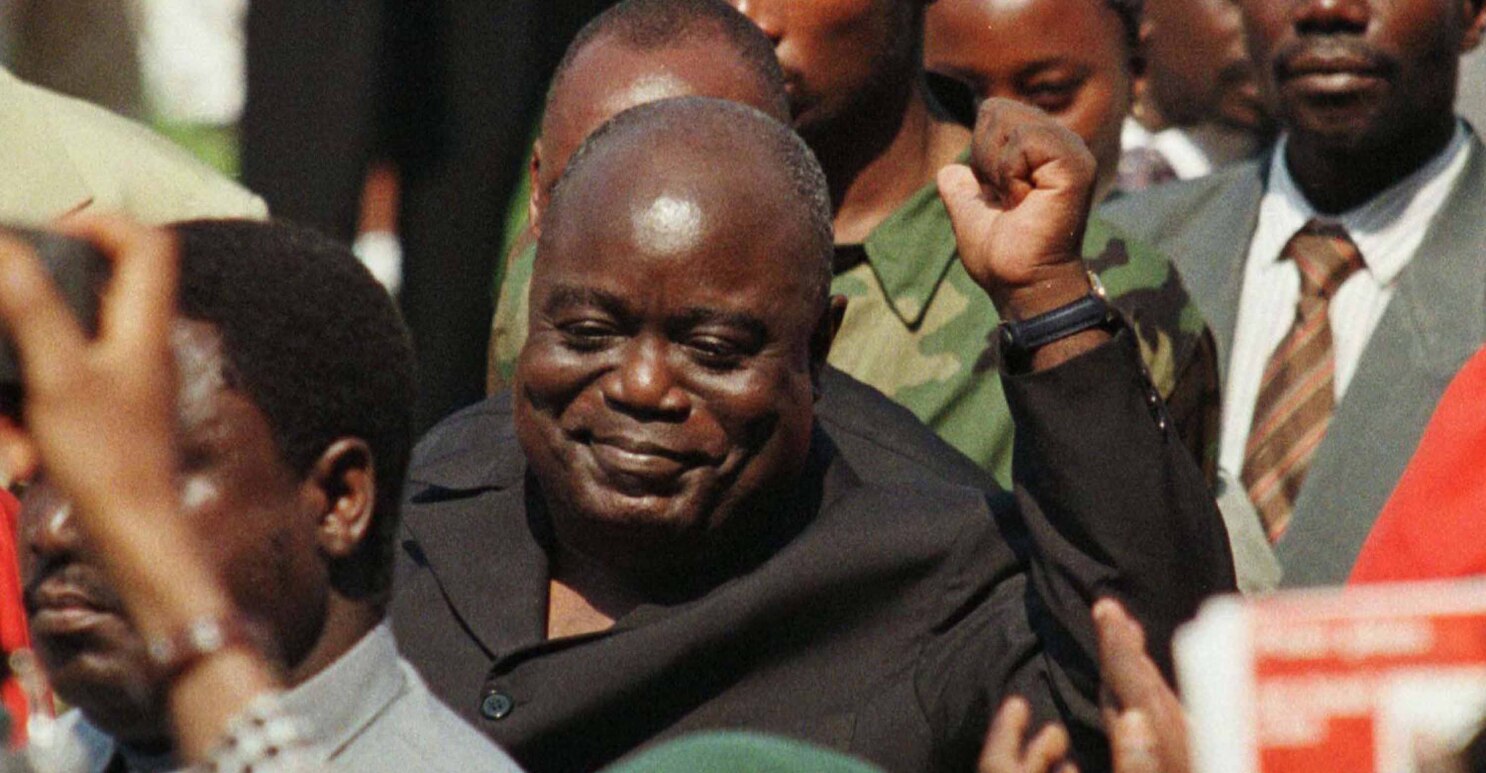
In 44 months of a turbulent presidency, Laurent Kabila, the rebel leader who became the president of DRCongo in May 1997, went from “a messiah”, “a saviour”, and “a leader more disposed to rationality and decency” who had “enormous personal credibility” to “a pillager”, “an idiot”, “a roly-poly revolutionary who preferred beer and brothels to Marxist salons”, who “was no more a president than a rebel leader”, who “swapped one set of foreign masters for another and both wearied of him.”
In the beginning when the West thought they had him in their grip, one Canadian mining magnate, salivating at the stunning mineral riches of Congo, declared: “We are going to capitalise on the current strife by increasing our presence and our land holdings in the country.” His quote was only bettered by a Johannesburg-based mining giant, who said “Cecil Rhodes must be spinning in his grave at the opportunities he is missing.”
In the end, when the West considered Kabila as having flown out of their grip, the Western media duly turned on him, calling him “a lazy, incompetent oaf who ate two chickens for breakfast”, “a petty tyrant who could not work with others”, “a thug and a pimp who attained the presidency almost by accident”, who “was not noted for his intellect or leadership qualities”, and whose “end [by assassination] was even fitting” and “a positive development”. Our editor, Baffour Ankomah, presents here the forked-tongue of the British (and by extension, the Western) media.
What they said about Kabila in 1997 (when he hobnobbed with the West)
The Daily Telegraph (of London)
Editorial comment, 16 April 1997
“Decades of misrule in Zaire have turned it once again into Africa’s heart of darkness. It is therefore natural that Laurent Kabila should be welcomed as a messiah in the towns which his rebels have taken from President Mobutu’s forces.
“Mr Kabila has shown himself no fool. He recognises the importance of regional sensibilities and has tuned his message accordingly… Too great a reliance on an ethnic minority and the governments of neighbouring countries will impede the formation of a broadly-based administration.”
The Independent (of London)
Editorial comment, 15 April 1997
“A remarkable thing has been happening in central Africa over the past few months… The rebel forces of Kabila have taken control of every important city in Zaire apart from the capital, Kinshasa. America, long Mr Mobutu’s ally in the Cold War, has let it be known that he has now served his purpose. By consigning him to the dustbin of history, Western countries are clearly hoping that the country can hold together under a leader more disposed to rationality and decency. The hope in the West is that Mr Kabila can provide that.
“The government forces are defending the father of kleptocracy. The primary function of the Zairean economy since Mobutu Sese Seko came to power 32 years ago, has been to enrich the president and his cronies. The secondary function has been to enrich those Western mining companies that have benefited from a symbiotic relationship with him. The main concern of the mining companies, as always, is the social discipline necessary to make profits and the government compliance necessary to repatriate them … Democracy is useful to them if it furthers these ends.
“Yesterday, Kofi Annan, the secretary general of the United Nations, appealed to [Kabila] to stop fighting and start negotiating over the future of the country. There is little reason for Mr Kabila to respond positively to this appeal. If he wants to be the next president of Zaire, that is not the best way to go about it. But he does appear to want to bring the country back into the world. He has already had informal contact with British diplomats outside the country, at his own request, as part of a strategy of building bridges to the West. Most importantly, he has already revealed a taste for power by consent, rather than power through fear. As long as this remains his taste, he should be encouraged.
Sam Kiley
The Times (of London)
22 April 1997
“Mining multinationals have signed billion-dollar deals for mineral rights with Laurent Kabila, Zaire’s rebel leader, to get ahead in what is being billed as ‘the second scramble for Africa’. Mining giants such as De Beers and American Mineral Fields have signed contracts, which are worth at least $3 billion (£1.8bn) a year, to develop Zaire’s copper, cobalt, gold, zinc, and diamond deposits with [Kabila’s rebel] forces, cutting the legally-recognised government [of President Mobutu] out of the picture.
“Executives with the companies said that they are happy to be doing business with the rebels, who control all of Zaire’s mineral resources other than its offshore oil fields because they do not ask for bribes. De Beers has also ditched its relationship with the fast-crumbling regime of President Mobutu and signed up with the rebels to get involved in a $500m a year diamond business.
“The usual alliance between big business and revolutionaries, many of whom were Chinese-trained Maoists and Marxists in their youth, has been accepted by Western governments, who see Mr Kabila as a man to lead Zaire out of three decades of corruption and staggering poverty.
“This week, American Minerals Fields signed three contracts worth $885m which would give the mining house access to the vast metal reserves of Shaba province. Other multinationals have been asked to provide satellite telephones to the rebels, who have argued that without them they would be unable to negotiate mineral rights deals internationally.
“Kenneth MacLeod, president of International Panorama Resource Corporation of Vancouver [Canada] said: ‘We are going to capitalise on the current strife by increasing our presence and our land holdings in the country.’ Another mining magnate based in Johannesburg gave the second scramble a historic twist: ‘Cecil Rhodes must be spinning in his grave at the opportunities he is missing.’”
The Guardian (of London)
Editorial comment, 19 May 1997
“History may conclude, for example, that the most lasting damage to Zaire was caused not by the CIA’s backing for Mobutu’s coups, but by the willingness of the US Export-Import Bank to bankroll his grandiose economic designs … The State Department said yesterday that US relations with the new authorities depends on Mr Kabila’s ‘commitment to democratic reforms, public accountability and respect for human rights’. It must be joking – since when did Washington lift a finger, during years of suffering by ordinary Zaireans, to demand observance of these principles by Mobutu?”
The Economist (of London)
Editorial comment, 17 May 1997
“When his rebel army started marching across Zaire, Laurent Kabila was seen simply as the man who might get rid of [the] hated President Mobutu. As his forces moved westwards almost unhindered, he was acclaimed as the country’s saviour … Is Mr Kabila up to it?
“A failed Marxist revolutionary from a bygone rebellion, he was plucked from the footnotes of post-colonial history by the leaders of Rwanda and Uganda … He has gone on to show that he is worth much more than small print. The worry is that he will try to become another strongman, all too ready to adopt the bad old ways of the regime he replaces.
“It would take someone with the probity of Lincoln, the magnanimity of Mandela and the organisational ability of IBM’s Deep Blue to turn Zaire into a properly functioning country at all quickly. It is Mr Kabila’s choice.”
Chris McCreal
The Guardian (of London)
19 May 1997
“It is too early to say if the new order in Congo fits the Museveni mould. What Kabila is and what he represents is unknown, but he has been greatly influenced by Museveni … [Kabila] has apparently won the support of most of his compatriots for vanquishing the old tyrant. Now comes the difficult bit. It will take years to make up for the lost decades …
“The West has already laid down demands for the Congo. The United States, fearing that [Kabila] does not fit its requirements, is the most vocal. Kabila has been told that he must satisfy the demands of the outside world and swiftly hold elections. If not, he will pay a price …
“The Americans kept alive the old myth, generated by Mobutu himself, that he was the only thing that held his country together. Washington nodded in agreement – without Mobutu there would be chaos. But [Kabila’s] rebellion brought order.”
Sam Kiley
The Times (of London)
19 May 1997
“Mr Kabila, 58, a member of the Luba tribe’s offshoot in Shaba province, has enormous personal credibility – he had been fighting the Mobutu regime for 32 years … A former Marxist and friend of Che Guevara, Mr Kabila has clearly given up the idealism of his youth. Before he took power [on 17 May 1997], he had already signed multi-million-dollar contracts with foreign mining companies to exploit Zaire’s staggering mineral wealth.”
Inigo Gilmore
The Times (of London)
28 May 1997
“In defiance of Western expectations, President Mandela demonstrated his support for the new regime in Kinshasa by backing Kabila’s widely criticised decision to ban all party-political activity in the [country]. Mr Mandela said it would be ‘suicidal’ to permit political activity until such time as the new government got a firm grip on law and order …
“Mr Mandela accused Western governments of demonising Mr Kabila. ‘You must judge what President Kabila is doing against the specific conditions that exist there’, Mr Mandela said, noting that 250 political parties exist in a country the size of Western Europe. ‘It would be suicidal for him to allow the operation of parties before he has a firm grip on the government of the country. I think that we can trust him, on the basis of his record, to keep his word.’”
What they said about Kabila when he refused to do what the West expected, and after his assassination on 16 January 2001
Alex Duval Smith
The Independent (of London)
18 January 2001 (two days after Kabila’s assassination)
“The heart of darkness was never darker. President Laurent Kabila, the latest in an uninterrupted line of pillagers of a territory the size of Western Europe, is dead. Now the vultures are massing for the next round of Africa’s First World War.”
Chris McCreal
The Guardian (of London)
19 January 2001
“Laurent Kabila was not noted for his intellect or leadership qualities…”
James Walker
The Independent (of London)
18 January 2001
“Incorrectly hailed in the West as one of Africa’s new leaders following his victory over Mobutu, Kabila was difficult to judge accurately as to his past, his true beliefs and inability to govern, precisely because very little was actually known about him.”
Chris McCreal
The Guardian (of London)
17 January 2001
Until four years ago, Mr Kabila was best known for the scorn Che Guevara poured on his fighting abilities when the Cuban revolutionary descended on Congo in the 1960s. He had waged a half-hearted civil war against Mobutu, but much of his time was spent in neighbouring Tanzania where he supplemented the booty from his ‘struggle’ by running a brothel. The small area of Congo under his control was subjected to a brutal rule which included witch-hunting.”
Sam Kiley
The Times (of London)
19 January 2001
“A roly-poly revolutionary who preferred beer and brothels to Marxist salons, Laurent Kabila became president by accident. The journey took him from jungle obscurity to untold wealth and violent death … How did a man with such limited attributes as Kabila, whose previous administrative experience had been running a failed 1960s rebel movement and a brothel, become president of a country the size of Western Europe and with the mineral wealth of Russia?
“‘We knew he was an idiot. In fact, we relied on his stupidity. That was our mistake,’ a member of Rwanda’s military intelligence told me. Kabila was seduced by multinational corporations involved in the second great scramble for Africa in a century. They rushed to get his signature on mining contracts. Within a year, he tore up most of the contracts and demanded [the] companies pay upfront for decades of future profits.”
Chris McCreal
The Guardian (of London)
19 January 2001
“Foreign forces on the rebel side have also been ‘self-financing’ their intervention, and making a tidy profit, too. Uganda’s gold exports have risen almost tenfold since its involvement in Congo, and its £400m trade deficit has been erased. President Museveni’s brother until recently had valuable gold mining concessions in Congo, and runs a profitable air cargo business to rebel-held territory. Other [Ugandan] officers control or lease diamond and cobalt concessions. The Ugandans also rely on the rebels they support to provide revenues from ‘taxes’ on tea, coffee and timber exports.”
Chris McCreal
The Guardian (of London)
17 January 2001
“In October 1996, Rwanda invaded Zaire to close the [Hutu] camps … But Rwanda’s Tutsi-led army needed a cover story. It chose to dress up the invasion as an indigenous uprising in eastern Zaire, and Mr Kabila was plucked from obscurity to front it.”
The Independent (of London)
Feature story, 18 January 2001
“Rwanda is the driving force behind the battle in [Congo]. Its Tutsi leadership wants to track down and kill the perpetrators of the genocide that wiped out a million Tutsis. Secretly funded by the CIA, Rwanda has military operations [in Congo] far above its means. [It] has 10,000 troops in [Congo].”
Chris McCreal
The Guardian (of London)
17 January 2001
“From the start, it was clear [Kabila] was not running the war. He spent much of his time resting in a villa in Goma while Rwandan troops drove Mobutu’s army back at amazing speed. While the Rwandan government initially portrayed Mr Kabila as a great democrat and soldier, its military commanders derided him as a lazy, incompetent oaf who ate two chickens for breakfast. He was no more a president than a rebel leader. He swapped one set of foreign masters for another and both wearied of him.”
The Economist Intelligence Unit (of London)
Press release, 18 January 2001
“[Kabila’s] exit from the scene can only be a positive development. It also removes a leader whose rule had degenerated to a farcical level of incompetence, corruption, and capriciousness. Even the end was fitting. He was assassinated at a meeting with a group of generals he was going to sack.”
The Economist (of London)
Feature story, 20 January 2001
“Politically, Mr Kabila was a petty tyrant who could not work with others … An old Maoist, he feared that the West wanted to recolonise Congo and steal its vast mineral wealth. He spurned the World Bank and the IMF. When mining companies and other investors rushed to Kinshasa to seek deals, he tried to play them off against each other. He broke agreements on a whim, relying on private bargains and connections. Offers of aid and investment were withdrawn; the economy languished.”
Michela Wrong
Financial Times (of London)
17 January 2001
“Laurent Kabila … alienated Western powers and African allies in his three-and-a-half years in power … He was welcomed as a liberator when his rebel forces marched into Kinshasa in 1997, toppling the late Mobutu Sese Seko, but diplomats and statesmen had come to view him as a man impossible to ‘do business with’, a key factor in central Africa’s growing instability … The World Bank and the IMF found him so obstructive, talks on new aid were abandoned.”
The Guardian (of London)
Editorial comment, 18 January 2001
“Kabila was, by all accounts, a thug and a pimp who attained the presidency almost by accident … But whatever the days ahead bring down upon its people’s heads, Congo is likely to remain what it has been ever since. Stanley [‘the British adventurer’, says The Independent] got off the boat; an enormous, lawless stage upon which are played out the very worst of mankind’s excesses and all-enveloping silence.”
Jane’s Intelligence Digest (of London)
Feature story, 17 January 2001
“When he took power in 1997, Kabila was widely welcomed as an alternative to the corrupt and discredited Mobutu who had … ceased to be a useful ally [of the West] after the end of the Cold War.
The Economist (of London)
Feature story, 20 January 2001
“The passing of Laurent Kabila from the Congolese presidency – and probably also, despite all the confusion, from the wider world – will not be mourned by many. Though hailed as a ‘new breed’ of African leader, his path to power was a trail of blood, and he ruled with the venality, incompetence and arbitrariness of the worst of the old breed. Still, for anyone tempted to help the wretched people of Congo, it is much less easy to say what should be done after the despot’s demise than what should not … The war there blights the entire continent. For the sake of all Africans, not just the Congolese, it is time to bring it to an end.”
The Independent (of London)
Editorial comment, 18 January 2001
“Congo’s agony is Africa’s agony. It is a giant, failed state, a huge power vacuum in the heart of what is increasingly depicted as a failed continent … Even so, we in Europe cannot look away. The history of post-Cold War Africa is a history of Western neglect. But the world’s richest countries, many of them former colonial powers, have both the means and the moral responsibility to seek a solution to the current Congo crisis…
“We must commit ourselves for the long haul … It also means a concerted policy by both the European Union and the United States who control the investment resources essential if Congo and other African countries in a similar predicament are ever to be put on their feet. The process will take years, perhaps decades. But that is no excuse not to attempt it at all.”
Mike Turner
Financial Times (of London)
24 January 2001
“Congo yesterday laid to rest its assassinated president, Laurent Kabila, with artificial flowers … It was an affair full of pageantry: a queue of brass bands took turns to belt out ear-splitting tunes, some mournful, many catchy enough to prompt a little toe-tapping from attendants.”
James Astill
The Guardian (of London)
24 January 2001
“Congo’s assassinated president, Laurent Kabila, was buried in the capital Kinshasa yesterday with his closet African bedfellows in politics and war in attendance. Whipped up by state propaganda, several hundred thousand people crowded the gates of the “people’s palace” government hall where the dead dictator lay in state.”
Danna Harman
The Times (of London)
24 January 2001
“The potholed streets of the capital were swept, women and children paraded in Sunday best, and crowds gathered around the People’s Palace – where Kabila’s body had lain in state for three days – to sing, dance, cry and watch … Locked outside the palace grounds and stirred on by loud music, a hot sun and rumours that ‘white people’ had been behind the murder, the crowd attacked journalists and other foreigners, screaming, pulling, pointing fingers and trying to push them to the ground. Tourist hotels put up barricades and suggested that their guests stay in.”
Alex Duval Smith
The Independent (of London)
24 January 2001
“A nation with very little seemed yesterday, once more, to have lost all it had.
As the mausoleum door was shut on the three-and-a-half-year reign of Kabila, assassinated last week, Congo entered a new phase of fear and uncertainty … Then, as the coffin, draped in the republic’s yellow-starred blue flag, was transferred to the mausoleum at the Palace of the Nation, thousands ran alongside the cortege. It was as if they were holding on to the only figure who – albert through war – had given the nation an identity.”
Baffour’s note:
Forked tongue – what forked tongue? Forty-four months are truly a long time in politics. I hope African journalists will read the above and be convinced about the necessity of loyalty to country and people. The British journalists quoted here were doing the somersault – praising Kabila in the beginning (when his so-called “rebel war” was being fought by the Americans and their Western allies directly and also through proxy via Rwanda and Uganda), and damning him in the end – all because Kabila turned against the West and its vast companies and corporations, and therefore he became an “enemy” deserving to be shot down by the Western media who had to perform their “historic task” of following the flag waved by their home countries and governments.
Leave a Reply