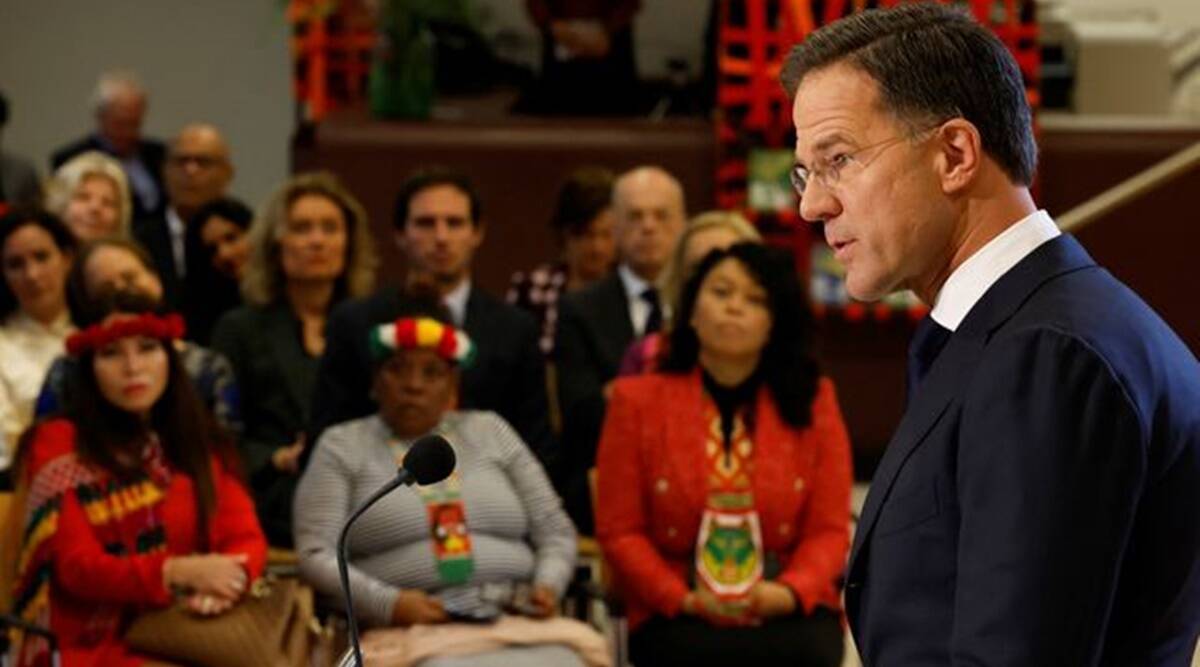
On Monday 19 December 2022, The Netherlands (or Holland, as it was once known), formally apologised for its historic role in “facilitating, abetting, stimulating, preserving and profiting” from centuries of slave trading, and for the consequences that continue into the present day. The Dutch prime minister, Mark Rutte, made the apology in The Hague on behalf of the country, just a month after The Third Eye had run an article in the November issue criticising the Dutch for not apologising for slavery. Tom Mbakwe reports.
“Today I apologise,” Prime Minister Mark Rutte said in a nationally televised speech at the Dutch National Archives. “For centuries, the Dutch state and its representatives facilitated, stimulated, preserved, and profited from slavery. For centuries, in the name of the Dutch State, human beings were made into commodities, exploited, and abused in the name of the Dutch State,” the prime minister said, adding that “successive Dutch governments after 1863 failed to adequately see and acknowledge that our slavery past continued to have negative effects and still does. For that I offer the apologies of the Dutch government.”
Rutte said slavery must be condemned as a “crime against humanity.” He explained that
he had experienced a personal “change in thinking” and that he was wrong to have thought that the Netherlands’ role in slavery was “a thing of the past.”
“It is true that no one alive now is personally to blame for slavery. But it is also true that the Dutch State, in all its manifestations through history, bears responsibility for the terrible suffering inflicted on enslaved people and their descendants,” he said, explaining that: “We are not doing this just to come clean. We are not doing this to leave history behind us.”
The apology came a month after The Third Eye had highlighted the Dutch guilt in an article published in our November issue, headlined: The Dutch royal family is as guilty as the British. The article focused on the fact that the Dutch had not made any apology for its part in enslaving Africans, almost 160 years after it abolished slavery in 1863.
The apology also came following a wider reconsideration of the Netherland’s colonial past and its current struggles with racism. Critics said the apology should have come from King Willem-Alexander, instead of Rutte.
Somehow, the run-up to the apology was fraught, with multiple groups of the descendants of the former enslaved Africans, saying that the government had not consulted them and that the occasion lacked any significance.
Rutte duly acknowledged that the runup to the announcement had been handled clumsily and said the Dutch government was sending representatives to Suriname, as well as the Caribbean islands that remain part of the Kingdom of the Netherlands with varying degrees of autonomy – Curacao, St Maarten, Aruba, Bonaire, Saba, and St Eustatius – to talk further about the apology.
Historians estimate that Dutch traders shipped over 600,000 enslaved Africans to the Americas, mostly to Brazil and the Caribbean. As many Asians were enslaved in the East Indies, especially in modern Indonesia. There are over 732,000 people reported to be of African ancestry in the Netherlands (4.20% of the total national population of 17.48 million people).
In other words, the Netherlands played a key role in the trans-Atlantic trade of enslaved people, primarily through the Dutch West India Company and the Dutch East India Company. The two organisations were established with private and state capital and governed by Dutch state officials and, later, royalty. While slavery was forbidden in the Netherlands, it was legal — and crucial to the profitable plantations — in Dutch colonies such as Brazil, Indonesia and Suriname.
A clarification
The Netherlands is sometimes referred to as Holland, which in fact, is a geographical region and former province on the western coast of the Netherlands. “From the 10th to the 16th century,” as Wikipedia explans, “Holland proper was a unified political region within the Holy Roman Empire as a county ruled by the counts of Holland. By the 17th century, the province of Holland had risen to become a maritime and economic power, dominating the other provinces of the newly independent Dutch Republic.
“The area of the former County of Holland roughly coincides with the two current Dutch provinces of North Holland and South Holland into which it was divided, and which together include the Netherlands’ three largest cities: the capital city Amsterdam, the home of Europe’s largest port Rotterdam, and the seat of government The Hague. Holland has a population of over 6.6 million.
“The name Holland has frequently been used informally to refer to the whole of the country of the Netherlands. This casual usage is commonly accepted in other countries, and is even employed by many Dutch themselves. However, some in the Netherlands (particularly those from regions outside Holland or the west) find it undesirable or misrepresentative to use the term for the whole country. In January 2020, the Netherlands officially dropped its support of the word Holland for the whole country, which included a logo redesign that changed “Holland” to “NL”.
Turning point
Aruba’s prime minister, Evelyn Wever-Croes, welcomed Rutte’s apology, saying it was a “turning point in history within the kingdom”. The apology came as a response to a national advisory panel, which was set up following the 2020 killing of George Floyd in the United States. The panel acknowledged that the Dutch participation in slavery had amounted to crimes against humanity, and in 2021 recommended an apology and reparations.
Rutte said his government embraced those conclusions, including that slavery had been a crime against humanity. However, he ruled out reparations, though the Dutch government has set up a euro-200m educational fund.
“What was completely missing from this speech is responsibility and accountability,” said Armand Zunder, chairman of Suriname’s National Reparations Commission, though he said the apology was a “step forward”. “If you recognise that crimes against humanity were committed, then the next step is you say I’m responsible for it, we’re liable for it … Indeed I’m talking about reparations.”
Many Dutch people take pride in the country’s naval history and prowess as a trading nation, the era they called their “Golden Age”. However, Dutch children are taught little of the country’s role in slavery and what the Dutch West India Company and the Dutch East India Company, key sources of national wealth, did during the era of slavery.
Today, despite the Dutch reputation for tolerance, racism is a significant problem in the country. Citizens of Antillean, Turkish and Moroccan ancestry report high rates of discrimination in their everyday lives, and recent studies have shown they face significant disadvantages in the workplace and in the housing market.
Zwarte Pete controversy
One important and controversial aspect of Dutch national life that Rutte’s apology did not touch is the tradition of Zwarte Piet (or Black Pete, in English). Every 5 December, pro-Black Pete celebrants dress up in funny clothes and paint their faces black in honour of what originally was a sidekick of Santa Claus (or Sinterklass, in Dutch) called Zwarte Piet. He helps Sinterklass by carrying his bag of goodies and gifts to entertain children.
“In the olden days, if children had behaved badly during the year, Pete would give them ‘the switch’. Or worse he would stuff them in a sack and take them away,” explains the Dutch author, Joost de Vries. “An elderly white man plays Sinterklass. Pete is played a white man too, dressed in minstrel clothing with his face painted black.”
For decades, says de Vries, “anti-racism activists have seen Black Pete as a prime example of how racism and traces of slavery are present in the ordinary traditions of Dutch culture today. In recent years people of colour have started speaking out, detailing how often they have been compared to Black Pete, jokingly or otherwise, and how offensive that is.”
A report published six years ago by the children’s ombudsman clearly stated that “many children of colour find the Black Pete season very troubling: during those weeks they are more often confronted with racial slurs, usually by other children who call them Black Pete and poke fun at them. But self-proclaimed pro-Black Pete activists have said that getting rid of Black Pete, or changing him, would be tantamount to selling out Dutch national identity.”
Prime Minister Mark Rutte, a liberal, has said his attitude to Black Pete has undergone “major changes”. In 2014, he revealed that he had dressed up as Black Pete himself in the past. Though anti-Black Pete activists see the 5 December tradition as an offensive relic of colonial times, Rutte is not ready to abolish it, despite the fact that many people, including children, have told him they feel discriminated against because Black Pete is black.
A June 2020 survey found that 56% of non-white people in the country faced discrimination in shops and businesses, 29% from the police, 40% in schools or universities, and 78% believe that institutional racism exists. But Rutte’s apology did not address those issues.
Generally, government apologies for slavery are rare. In the USA, the lower house of parliament, the House of Representatives, gave one in 2008 for the institution of slavery and for Jim Crow laws. In 2018, Denmark apologised to Ghana for the Danes’ role in the trans-Atlantic slave trade. During a visit to DRCongo in mid-2022, the king of Belgium expressed his “deepest regrets for these wounds of the past,” but stopped short of an apology.
A day before Rutte’s apology, a group of descendants of enslaved people stood in Amsterdam’s frigid temperatures in front of the Royal Palace to protest against the apology and the way the government had handled it. Many said they felt the apology had been forced upon them.
“We came here to make noise against an apology that’s being rammed down our throats,” Reggie Hoogvliets, one of the protestors, said, adding that he would not accept Rutte’s apology, partly because the government did not speak to the right stakeholders and descendants of enslaved people. According to him, more communication and a meaningful date would have made the apology more palatable.
St Maarten
Hoogvliets’ view was shared by the prime minister of St Maarten, Silveria E. Jacobs, who issued a long, strongly-worded statement neither accepting the apology nor rejecting it. For the sake of posterity, her statement needs to be quoted in extensor here.
“Dear people of Saint Maarten, both South and North, our sisters and brothers in Aruba, Curacao, Bonaire, Saba, Sint Eustatius, Suriname – and to the indigenous people of this region and the people of the wider diasporas across the Caribbean and Atlantic worlds,” she said, “I address you today with mixed emotions and extend an invitation to openly dialogue on the ways to approach this abrupt and forced apology for ‘Slavery past’ by the Netherlands.
“This is a matter of historic proportions and a dialogue long overdue, which affects and emotes us all. Why mixed emotions, one may ask? Because on one hand, the seriousness of the occasion, if it is sincere, is not lost on me, especially seeing the recent public statements on this topic.
“On the other hand, the manner in which we arrive here today, is messy, and exposes many risks in the realisation of true reparatory justice for those impacted by the transatlantic slave trade, the enslavement of our ancestors, and subsequent racism, marginalisation and continued existence of colonialism in the relationship and institutions which still exist within the Kingdom [of the Netherlands].
“Along with my colleagues throughout the Dutch Caribbean, I find myself forced to confront our traumatic histories according to the schedule/timeline set by the Netherlands. And because these hard-felt sentiments comprise more emotion than one is allowed to express in post-coloniality, I am compelled to secure justice for our ancestral pains by means of formalities and speeches…
In our many discussions since 6 September [2022], when the first meeting was forced to “hear” us, it was explained that this is not the way to properly dialogue on a topic of such enormous proportions. Repeatedly this sentiment has been conveyed that it is in poor taste to move full steam ahead with the apology before proper dialogue had taken place, without proper respect for the feelings of the people whom they want to apologise to, the descendants of those who endured the most devastating crime against humanity.
Yet today, here we are, hearing a statement heretofore shrouded in secrecy as to the real motives, the need for haste, and the significance of the chosen date. My questions remain: Why the haste? Why the sudden change of heart? Why no proper dialogue with us as descendants of the enslaved to determine what a meaningful and sincere apology should minimally contain? How do these actions taken without regard to how they will be experienced enhance/diminish the fragile relationship within the Kingdom?
As people of colour, and in particular the descendants of slavery, we are emphatically disallowed to approach slavery and decoloniality in our own ways. We are discouraged to show emotion and to remain rational while we address trauma through the logic, lens, and statistics of the Western imperial paradigm.
Negating their proximity to our humanity is the same tool they used to justify the dehumanisation of our ancestors. Therefore, the ways in which we approach reparations and decoloniality cannot stem from this same paradigm. How we address reparations is equally as important as what we need to address.
In other words, an apology cannot be crafted according to the terms of a mere Eurocentric paradigm. To do so, would not only be an exercise of colonial obedience, but also a failure to truly understand and empathise with the sentiments of the human persons who have historically been relegated as property – thus less than human.
Therefore, it is important that the tools and language used in the discourse surrounding an apology for the atrocities committed during the enslavement of our ancestors, and the subsequent reparations, be in one that our general public understands.
Currently, the government of St Maarten is in the process of establishing an advisory committee on slavery past, atonement and reparations to ensure true research, engagement and discussions by, and with, the people and diaspora communities in St. Maarten. This will ensure that we have a clear vision of what the full damage is, and can articulate what actions will be necessary to repair the said damage. So for St. Maarten, the statements made today are but the beginning of the dialogue in which we must and will play a leading role.
The Netherlands has proposed to create a fund of 200 million euros for awareness and education and the investment of 27 million euros to construct a slavery museum. Built on European soil, this institution is meant to bring awareness to the Dutch atrocities during their Golden Age to the general population of the Netherlands.
Ostensibly, such an enterprise can be conceived as an admittance of ignorance regarding the subject of slavery and colonialism. How can a nation admittedly ignorant of their own colonial violence determine the conditions for an apology, let alone reparations?
How can a nation be sorry for something they admittedly know little to nothing about, and have only recently seen the need for the current actions? Again, we see here a demonstration of Eurocentric thinking, hence it is dangerous and irresponsible to root an apology in Eurocentric dogma and entitlement.
What was the Golden Age for the Netherlands was an apocalypse for us. To frame Black and Indigenous People Of Colour (BIPOC) and Caribbean histories around coloniality alone, recklessly perpetuates the notion that our narratives and identities can only exist in relation to the coloniser.
We must be allowed the time and space needed to reconnect with our histories beyond coloniality as a precursor to setting the conditions for reparations. Under the purview of institutionally-induced amnesia through colonial streams of pedagogy, how can we know what to negotiate for, if most of us cannot remember who we are?
Appeal to Africa
The issues and real implications of an apology and retribution are far more complex than any one of us can conceive alone. Therefore, I am reaching out not only to my own brothers and sisters in the Caribbean, particularly those in Caricom, and the CRC who are ready and willing to assist in this process, but also to our brothers and sisters on the African content.
The Dutch West India Company’s grip on the slave trade denotes transnational repercussions, both historically as well as presently. Via their slave entrepots in Curacao and Saint Eustatius, many of our ancestors were shipped by the Dutch to and from places beyond the nations addressed in their apology. In other words, the Dutch owe an apology to more than just their Dutch Caribbean counterparts.
By only addressing the apparent vestiges of Dutch imperialism in the contemporary political landscape, this apology fails in actually addressing the past while erasing the true scope of their colonial violence. It is with this thought, that I look forward to the outcome of the investigation of the King into the royal family’s contribution to the period of enslavement of Africans, and the transatlantic slave trade.
Trust is built, not demanded. Apologies without action only serve to absolve the perpetrator of guilt with minimal repercussions. As a proponent of these actions as the precursor to an apology, I have formally requested that these actions be put in writing. Though unsurprising, to my dismay, I have been denied this request by the Dutch State until they are ready to make the statements, seeing that the response to the report and subsequent statement was only approved by the Dutch government on Friday 16 December [2022].
Documentation allows for transparency, and this transparency crucially propels the decolonisation process. Transparency helps to shed light on the structures and imbalances of power. Today, this is demonstrated by shortsighted proposals for colonial retribution, as well as the costs to the island nation of St Maarten to cover the visit of the Dutch Royal Family following this forced apology.
For this apology today to be sincere, it must come with the realisation that slavery and colonialism have impaired our people’s economic and social development. Formally reported in various news media outlets last week, institutionalised racism is an inherent trait at the Ministry of Foreign Affairs in the Netherlands.
Colleagues at the Kingdom’s Ministry of Foreign Affairs have referred to African countries as “apenlanden”, meaning “monkey countries”. The recent bullying and violence by citizens in Staphorst against the peaceful anti-Black Piet/Blackface protestors is yet another example of racism in the Netherlands. It is clear that discrimination and institutionalised racism exists at all levels of society and organisations within the Netherlands. So education and awareness is surely needed at all levels.
These inherent prejudices, racisms, and/or colourism are systemic and insidious; and do not only affect the socio-economic disposition of the descendants of chattel slavery but the very psyche, spirit, and soul of the said persons.
Post Traumatic Slave Syndrome
According to the theory of Post Traumatic Slave Syndrome (PTSS), the slavery trauma is held in our DNA and is passed down from one generation to the next. PTSS exists as a direct consequence of the multigenerational oppression of Africans and their descendants resulting from centuries of chattel slavery. If we are to have any real discourse on restoration, reconciliation, and reparations; we must first identify and address PTSS that still lingers in our society today.
Lastly, I would like to state that financial aid and loans provided thus far by the Netherlands can never be conceived of as part of reparations owed as a result of the expected apology. Reparations and aid as a result of crises are not to be discussed in the same breath in a sincere apology.
Historically, with regards to exercising our own agency and self-determination within the Dutch Kingdom Structure, we have been in the position to exchange colonial obedience for aid and loans. This was the case after the onslaught of Hurricane Irma in 2017 and the Covid-19 pandemic.
I would only hope that a truly sincere apology would include the right to self-determination and agency. When working towards a new decolonial age of equity and equality, one should not be punished for colonial disobedience. The government and people of St Maarten will not be placed on the spot today to accept or deny the apologies.”
Leave a Reply